
Transmission lines are essential for moving electrical power from power stations to homes, businesses, and industries. However, when transmission lines are not properly balanced, it can cause problems. In this guide, we’ll explain transmission line unbalance, what transposition is, and how both affect power transmission. By the end, you’ll understand why these concepts are important in keeping the electricity flowing smoothly.
What Is Transmission Line Unbalance?
In an ideal transmission system, the three wires (called phases) that carry electricity should be placed symmetrically, ensuring that the voltage and current are equal across all three phases. However, transmission line unbalance happens when the positions of the three conductors are not symmetrical. This causes differences in the voltage and current, which leads to a variety of issues such as:
- Voltage Fluctuations: If the voltages across the three phases are not balanced, some equipment might malfunction.
- Energy Losses: Unbalanced voltages cause higher energy losses, which reduces efficiency.
- Equipment Damage: Continuous imbalance can heat up electrical equipment, causing wear and tear or even failure.
Why Is Transposition Important?
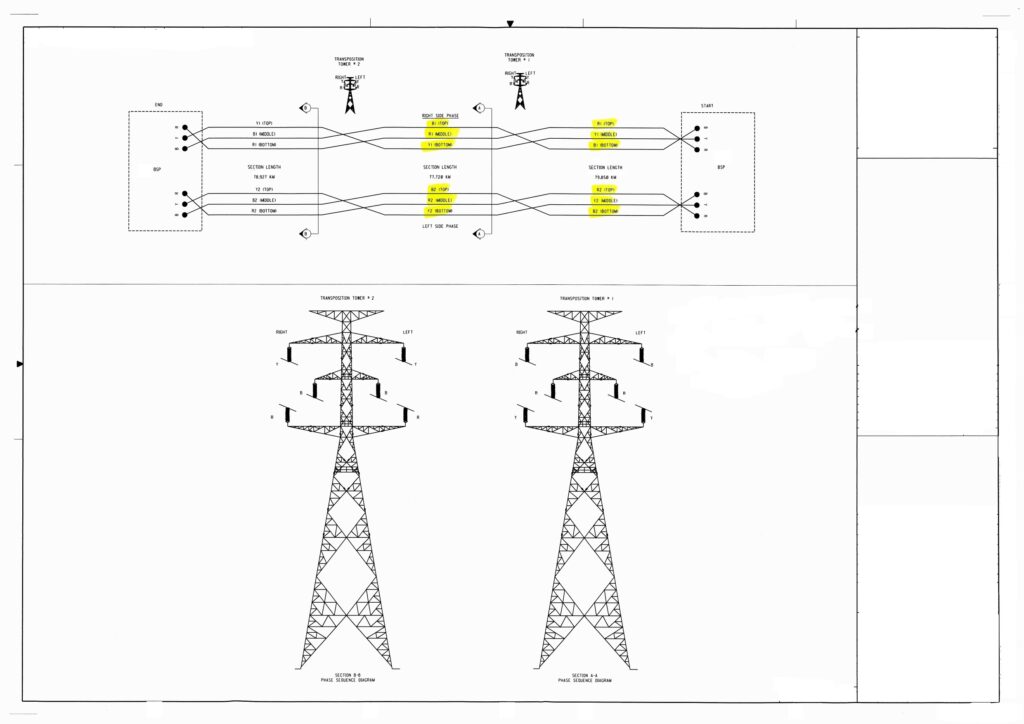
Transposition is a technique used to fix transmission line unbalance. Essentially, transposition involves changing the positions of the conductors along the transmission line. By rotating the positions of the three conductors (R, Y, and B), each conductor gets to occupy all three positions for an equal amount of time. This helps balance the system and reduce the negative effects of unbalance.
Here are the key benefits of transposition:
- Balances the Magnetic Fields: By swapping the positions of the conductors, the magnetic fields generated by the currents in the conductors become more balanced.
- Stabilizes Voltage: It helps to ensure the voltage across all three phases remains uniform, making the system more stable.
- Reduces Interference: Transposition helps minimize induced currents that might interfere with other nearby systems, such as communication lines.
ALSO READ: PLS-CADD Workflow: A Complete Guide to Overhead Line Design and Optimization
When Do We Need Transposition?
The need for transposition depends on the length of the transmission line. Long-distance transmission lines are more likely to experience imbalances because of their extended length. To address this, transposition is carried out at certain intervals along the line.
Here’s a breakdown of transposition requirements for different types of transmission lines:
- For 230 kV and 380 kV Transmission Lines:
- If the transmission line is longer than 90 km, it needs to be transposed at certain intervals.
- For 90 to 270 km lines, one complete transposition is required, which involves three structures along the line.
- For lines longer than 270 km, two complete transpositions are necessary, which involves six structures.
- If the transmission line is longer than 90 km, it needs to be transposed at certain intervals.
- For Shorter Transmission Lines (69 kV, 110 kV, 115 kV, 132 kV):
- These lines are typically shorter and often don’t require transposition. However, in cases where they are longer or carrying high loads, transposition may be needed. The Network Planning Department (NPD) decides whether transposition is necessary based on specific circumstances.
How Does Transposition Work?
Transposition structures are placed along the transmission line at intervals to change the positions of the conductors. Depending on the type of transmission line (horizontal or vertical), the transposition could look slightly different:
- Horizontal Configuration (Single Circuit): In a horizontal setup, the conductors are placed side by side. Transposition is done in segments (e.g., one complete transposition for every 90-270 km of line length).
- Vertical Configuration (Single or Double Circuit): In a vertical setup, the conductors are stacked one on top of the other. Similar to horizontal configurations, transposition is done at specific intervals along the line to maintain balance.
Phase Designation and Sequence
In any power system, it’s important to correctly label the phases of the transmission line. Each phase is assigned a color: R (Red), Y (Yellow), and B (Blue). When a transmission line is un-transposed, the phases are placed in a specific order, typically from left to right or top to bottom, depending on the line’s configuration.
When the transmission line is transposed, the phase order may change to keep the system balanced. For example, if the initial setup was RYB, after transposition, the phases might be RYB-BYR for a double-circuit line. This change helps reduce unbalance and ensures the system works smoothly.
Transposition and Communication Lines
Sometimes, untransposed transmission lines can cause interference with nearby communication lines, like telephone lines. This happens because the unbalanced currents in the transmission lines can induce unwanted signals into the communication system.
To avoid this, engineers can transpose the communication lines as well, or bury them underground to reduce interference. Transposing the power lines themselves is often the most cost-effective way to solve this problem.
Conclusion: Why Transposition Matters
In conclusion, transmission line unbalance is a significant issue that can lead to voltage instability, equipment damage, and operational inefficiency. Transposition is a practical solution that helps reduce these problems by ensuring the conductors are symmetrically placed along the line. By following specific guidelines for different voltage levels and line lengths, transmission systems can operate more efficiently and reliably.
Transposition also plays a crucial role in reducing the risk of interference with communication systems and preventing problems related to ground wire currents. Whether you’re dealing with high-voltage transmission lines or shorter lines, understanding and applying transposition is key to keeping the power flowing smoothly.
I understand complete concept in detail of transposition, excellent article
Thank you Siva
Too good and written in easy way. Also few information like placement of TR tower in horizontal and vertical configuration is missing.
https://top10electrical.com/
Thank you for the information, very helpful