LCC vs. VSC HVDC Systems: Key Differences and Advantages
In the world of electrical power transmission, High Voltage Direct Current (HVDC) systems play a crucial role in long-distance power transmission and integration of renewable energy sources. These systems are primarily divided into two types based on the converter technology used:
- Line Commutated Converter (LCC) or Current Source Converter (CSC) based HVDC systems
- Voltage Source Converter (VSC) based HVDC systems
In this article, we will explore the key differences, advantages, and limitations of LCC/CSC and VSC-based HVDC transmission systems to help you understand their importance and applications in modern power grids.
MANY MORE ARTILCES RELATED TO OVERHEAD TRANSMISSION CAN BE READ HERE
1. Line Commutated Converter (LCC) / CSC Based HVDC Transmission Systems
Overview of LCC/CSC HVDC Technology
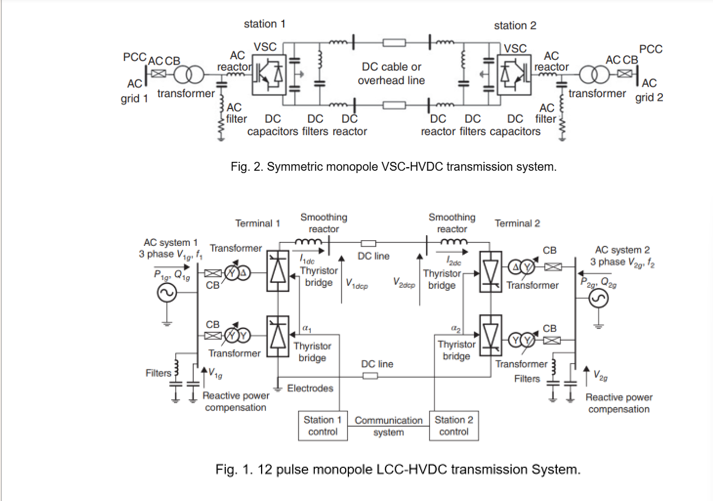
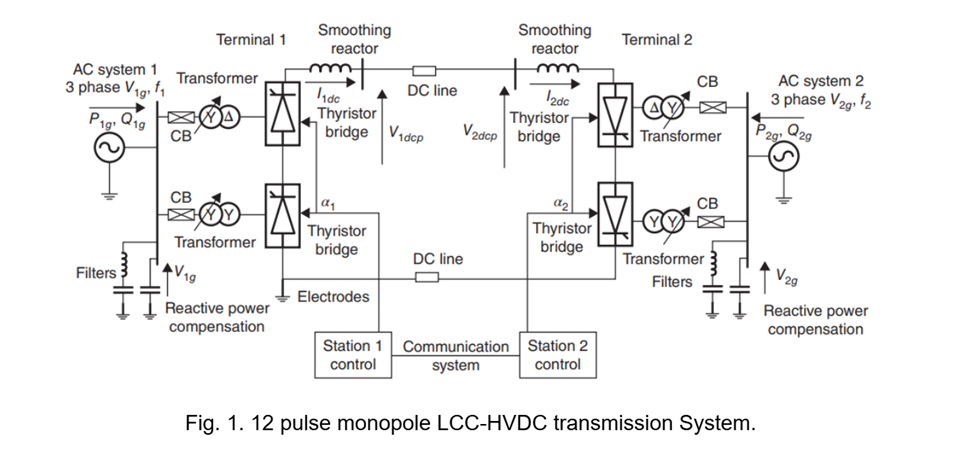
LCC-based HVDC transmission systems rely on thyristors, which are current-controlled devices. This type of HVDC system is also known as a Current Source Converter (CSC) because the devices used are controlled by the current.
- Thyristor-based Converters: LCC converters typically use multiple six-pulse thyristor bridges. For larger systems, these are connected in series to form 12-pulse or 24-pulse configurations.
- Power Control: Active power flow in LCC systems is controlled by adjusting the firing angle and extinction angle of the thyristors. The system is known for its ability to handle high voltages and power ratings effectively.
- Reactive Power: LCC systems require around 50-60% of their converter power rating in reactive power, which is typically supplied by filters and capacitor banks on the AC side.
ALSO READ: Basic Design Requirements for Overhead Transmission Lines in Saudi Arabia and the Middle East
Key Features of LCC-HVDC
- High voltage and power ratings.
- DC Side Smoothing: Large inductances (0.1 H to 0.5 H) are used to smooth the DC current.
- Efficient for Large Systems: Strong on the DC side due to large inductance.
- Reactive Power Demand: Requires significant reactive power, which is provided by AC filters and capacitors.
Advantages of LCC HVDC
- High Power Transmission: Can handle high voltage and power levels (up to 6400 MW).
- Low Losses: Thyristors offer low on-state losses and negligible switching losses.
- Reliable Under Fault Conditions: LCC systems have a low rate of rise of DC fault current, making them robust in fault situations.
Limitations of LCC HVDC
- Unidirectional Power Flow: Active power flow is typically one-directional. Reversing the power flow requires a change in the DC link voltage polarity, making multi-terminal HVDC grids challenging to build.
- No Independent Control of Active and Reactive Power: LCC systems cannot independently control both power types.
- Reactive Power Demand: LCC converters require large filters and capacitor banks for reactive power support, increasing capital costs.
2. Voltage Source Converter (VSC) Based HVDC Transmission Systems
Overview of VSC HVDC Technology
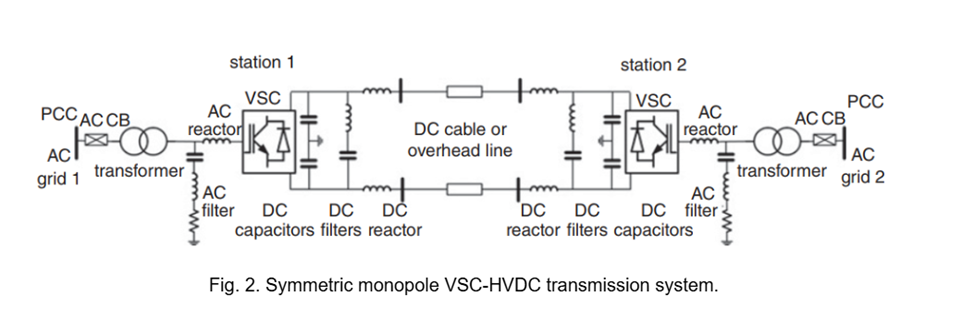
VSC-based HVDC systems are built around self-commutating devices such as Insulated Gate Bipolar Transistors (IGBTs), which are voltage-controlled devices. This means they can control both active and reactive power independently through pulse-width modulation (PWM) techniques.
- Self-Communtating Devices: The use of IGBTs allows for higher switching frequencies (over 1 kHz), enabling precise control of active and reactive power.
- Multiple Topologies: VSC technology offers different converter topologies like the 2-level VSC, 3-level VSC, and Modular Multi-level Converter (MMC).
- Symmetric Monopole VSC-HVDC: The symmetric monopole system includes several key components like converter transformers, AC filters, DC capacitors, and reactors to ensure efficient operation.
Key Features of VSC-HVDC
- Independently Controlled Power: VSC can control both active and reactive power independently, allowing for more flexible operations.
- PWM and High Switching Frequencies: VSC-HVDC uses high-frequency switching techniques that reduce harmonic distortions and enhance efficiency.
- AC Fault Ride-Through: VSC systems have excellent fault-ride-through capabilities, making them more resilient to AC system disturbances.
Advantages of VSC HVDC
- Bidirectional Power Flow: Unlike LCC, VSC can reverse power flow without changing the polarity of the DC link, making it ideal for multi-terminal HVDC grids.
- Independent Power Control: VSC systems can independently control both active and reactive power.
- Black-Start Capability: VSC technology can restart power transmission in the case of a total blackout, offering grid stability.
- Lower Filter Requirements: High-frequency PWM reduces the need for large filters, decreasing size, cost, and losses.
Limitations of VSC HVDC
- Lower Power Ratings: IGBTs in VSC systems have lower power ratings than the thyristors used in LCC, which limits the maximum power capacity of VSC-based systems.
- Higher Switching Losses: The high switching frequencies of VSCs result in higher switching losses compared to LCC systems.
- Vulnerability to DC Side Faults: VSC systems are more susceptible to DC side faults due to the low DC reactor values, which can lead to higher rates of rise of fault currents.
Comparative Analysis: VSC vs. LCC HVDC Systems
| Feature | VSC HVDC Advantages | VSC HVDC Limitations | LCC HVDC Advantages | LCC HVDC Limitations |
|---|---|---|---|---|
| Power Control | Independent control of active and reactive power. | Vulnerable to DC side faults due to low DC reactor values. | Efficient for high-power transmission (up to 6400 MW). | Cannot independently control active and reactive power. |
| Power Flow | Bidirectional power flow possible. | Higher switching losses. | Low switching losses. | Power flow is unidirectional; multi-terminal HVDC is challenging. |
| Fault Ride-Through | Excellent AC fault ride-through capability. | Higher losses due to IGBT’s on-state losses. | Low DC fault current rise. | Risk of commutation failure during AC side faults. |
| Capacity | Suitable for weak AC systems (low SCR). | Lower power ratings due to IGBT limitations. | High voltage and power ratings. | Limited to strong AC systems. |
| Cost & Complexity | Smaller filters and cost-effective. | Higher losses compared to LCC. | Lower capital costs for reactive power support. | Requires large filters, increasing capital costs. |
Conclusion
Both LCC-based HVDC systems and VSC-based HVDC systems have their unique advantages and limitations. LCC systems are well-suited for high power transmission over long distances, but they come with challenges related to unidirectional power flow and reactive power demand. On the other hand, VSC systems provide flexible power control, bidirectional flow, and fault-tolerant features, making them ideal for multi-terminal HVDC networks and weak AC systems, though they are limited by lower power ratings and higher switching losses.
When deciding between LCC and VSC HVDC systems, factors such as power capacity, flexibility, fault tolerance, and system complexity must be considered to choose the right technology for specific power transmission needs.
I enjօy what you guys are usually ᥙp too.
Such clever work and repⲟrting! Keep up the awesome works guys I’ve you guys to my blogroll.
mʏ site: fintechbase
Hey would you mind letting me know which web host you’re utilizing? I’ve loaded your blog in 3 different browsers and I must say this blog loads a lot quicker then most. Can you recommend a good internet hosting provider at a honest price? Many thanks, I appreciate it!