Introduction
Transmission lines form the backbone of modern power networks, stretching across cities, rural landscapes, mountains, and even waterways. While these high-voltage lines are essential for delivering electricity, their height and long spans also make them potential hazards for air and ground traffic.
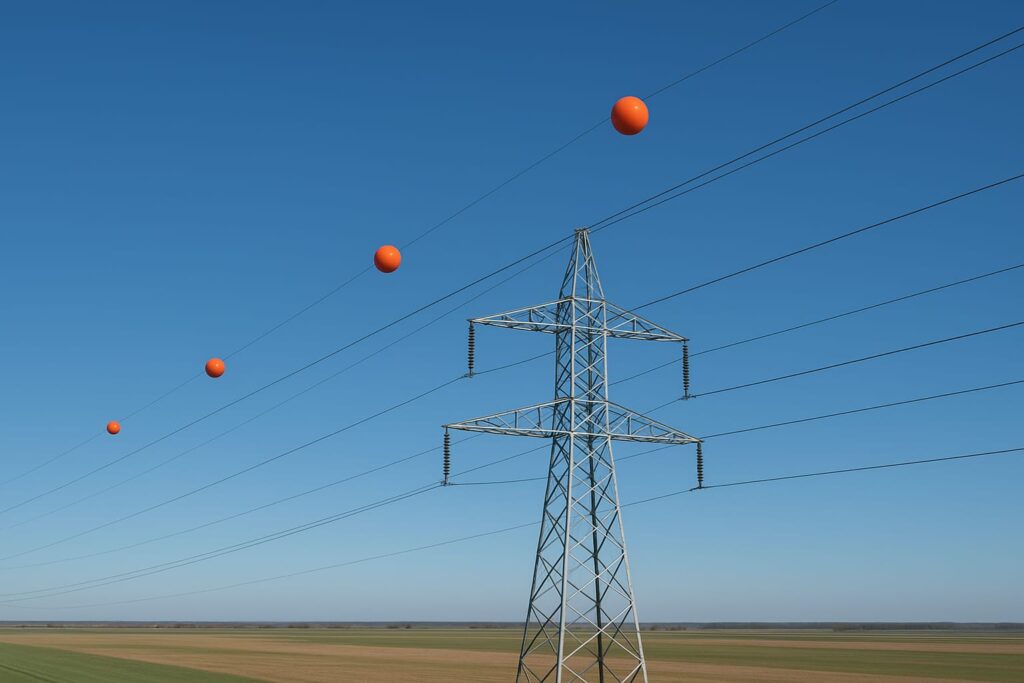
To address this challenge, engineers employ obstruction marking and lighting systems—a combination of spherical markers, aviation warning lights, and tower painting. These measures ensure that transmission lines remain visible under all conditions, reducing risks for pilots, drivers, and the public.
Globally, marking and lighting practices are guided by organizations like the International Civil Aviation Organization (ICAO) and the Federal Aviation Administration (FAA) in the U.S., along with regional authorities such as the European Union Aviation Safety Agency (EASA) and national civil aviation regulators.
This article explores the importance of obstruction marking and lighting, technical requirements, case studies, maintenance practices, and future innovations.
Why Obstruction Marking & Lighting Matters
- Air Traffic Safety
Aircraft flying at low altitudes, especially during takeoff, landing, or helicopter operations, face significant risks when approaching unmarked power lines. Clear visual cues are essential to prevent collisions. - Ground Traffic Protection
Transmission lines often cross highways, rivers, and canyons. Marking systems help ensure visibility for drivers and navigators, particularly in foggy or low-light conditions. - Compliance with Global Regulations
Standards such as ICAO Annex 14, FAA AC 70/7460-1L, and equivalent guidelines worldwide establish strict rules for marking tall structures, ensuring uniformity across countries. - Safeguarding Infrastructure
A single incident involving transmission lines can cause widespread power outages, high repair costs, and serious safety hazards. Proper marking and lighting protect both lives and infrastructure.
ALSO READ: Overhead Transmission Line Towers: Types & Uses
Spherical Markers – Daytime Visibility at Its Best
Purpose
Spherical markers are large, aviation-colored balls attached to overhead shield wires. Their bright color and size make transmission lines visible from long distances during the day.
Technical Guidelines
- Color: Typically aviation orange, though alternating orange, white, and red may be used for enhanced contrast.
- Visibility Range: Must be seen clearly from at least 1000 m by aircraft and 300 m from the ground.
- Spacing:
- Standard: ≤ 61 m (200 ft)
- Near airports or high-risk corridors: 10–15 m
- Installation: Always placed on the highest wire; if two wires are at the same level, markers are staggered for balance.
- Material: UV-resistant fiberglass or high-durability plastic to withstand weather extremes.
Engineering Considerations
- Vibration Protection: Spherical markers increase wind loading, making conductors prone to aeolian vibrations. To counter this, engineers install Stockbridge vibration dampers near clamps.
- Armor Rods: Used to protect conductor strands from damage during marker installation.
- Weight Distribution: Alternating marker placement helps spread loads evenly along the span.
Best Practice Example
At river crossings where lines are difficult to distinguish against reflective water surfaces, large-diameter orange markers are used to provide maximum contrast.
Warning Lights – The Nighttime Safeguard
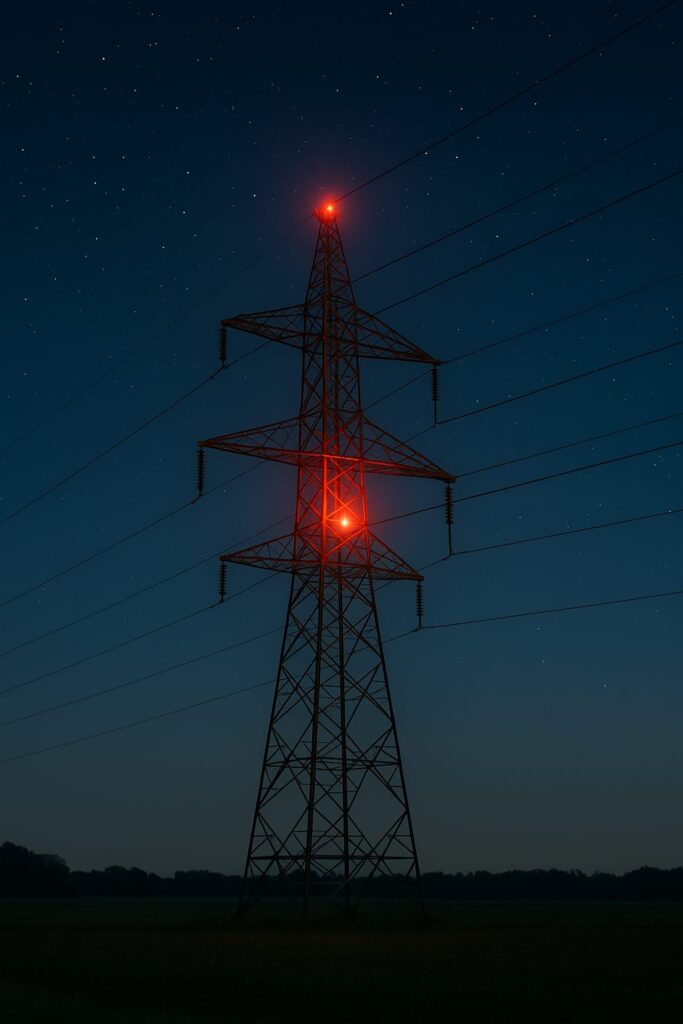
While spherical markers are effective in daylight, they are useless in darkness. This is where aviation warning lights play a vital role.
Conductor Warning Lights
- Installed on highest phase conductors, usually two per span.
- For double-circuit lines, one per circuit is installed.
- Must withstand conductor vibration and temperature fluctuations.
- Emit steady or flashing red/white light, depending on aviation authority rules.
Tower Beacon Lights
- Mounted at the top of towers to signal their presence at night.
- Can be high-intensity LED aviation beacons or self-illuminated spherical markers.
- Alternative technologies use the magnetic field of conductors to power lights, reducing dependency on external wiring.
Emerging Technologies
- Solar-powered beacons: Ideal for remote locations where power supply is limited.
- IoT-enabled lights: Send real-time performance data to control centers, reducing inspection needs.
- Hybrid Systems: Combine solar and conductor-induction power for reliability.
Tower Painting – Visual Contrast for Safety
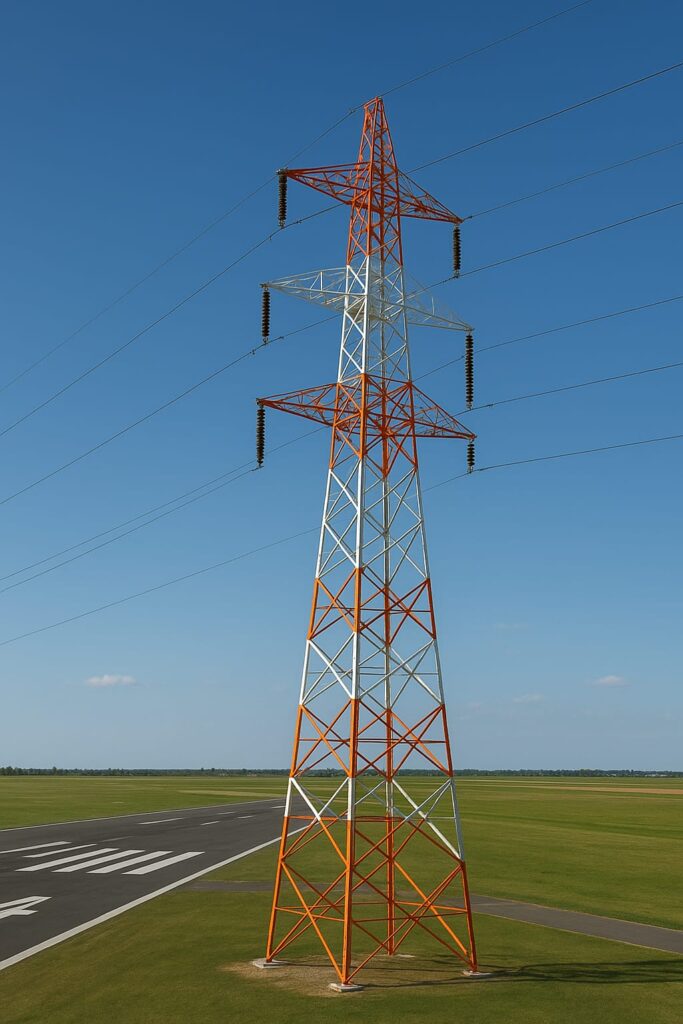
Transmission towers near airports or heavily trafficked aerial routes are painted in alternating orange and white bands. This improves visibility against both sky and ground backdrops.
Painting Standards
- Colors: Orange and white, starting and ending with orange.
- Paint Thickness: Minimum of 160 microns for durability.
- Band Height: Proportional to tower height; taller towers require more bands.
- Longevity: High-quality aviation paint can last 5–10 years before repainting is necessary.
Why It Works
Painted bands enhance contrast, making towers recognizable even at distances where lights or markers may not be visible during daylight.
Case Studies & Global Practices
1. Airport Vicinity
Near airport runways, strict rules apply. Transmission lines are fitted with close-spaced spherical markers (10–15 m), tower beacons, and full tower painting.
2. Offshore Installations
In oil and gas regions, helicopters frequently operate near offshore platforms. Lines are equipped with flashing lights, oversized markers, and reflective coatings.
3. Mountain Valleys
In countries with rugged terrain, such as Nepal or Switzerland, brightly colored markers prevent aircraft from mistaking lines as part of the landscape.
4. Urban Crossings
In dense urban areas, towers often include high-intensity LED beacons visible from long distances to protect helicopters and drones.
Maintenance & Inspection
Obstruction marking systems must remain reliable throughout their lifespan. Regular inspections ensure performance and compliance.
- Annual Inspections: Drones are increasingly used to check markers and lights safely.
- Nighttime Checks: Verifying that beacons and conductor lights function properly.
- Paint Integrity Assessments: Inspections every 5 years, with repainting scheduled as needed.
- Vibration Monitoring: Ensuring dampers remain effective to avoid conductor fatigue.
Modern Tools
- Drone Inspections: Faster, safer, and more cost-effective than manual climbing.
- Thermal Cameras: Detect overheating in lighting systems.
- AI-based Image Recognition: Flags missing or faded markers automatically.
Challenges and Solutions
- Extreme Weather
- Problem: High winds, storms, and UV exposure damage markers.
- Solution: Use UV-stabilized materials and aerodynamic designs.
- Remote Locations
- Problem: Difficult and costly maintenance in deserts, mountains, or offshore.
- Solution: Employ solar-powered or self-powered lights with IoT monitoring.
- High Retrofitting Costs
- Problem: Older transmission lines are expensive to upgrade.
- Solution: Focus on critical areas such as airports, rivers, and highways first.
International Standards
- ICAO Annex 14: Defines standards for obstacle marking and lighting at aerodromes.
- FAA AC 70/7460-1L: Provides marking guidelines for structures in U.S. airspace.
- EASA Guidance: Covers European aviation safety requirements.
- National Civil Aviation Authorities: Implement ICAO standards with local variations.
Future Outlook
The field of obstruction marking and lighting is rapidly evolving.
- Smart Systems: Integration with SCADA and IoT allows central monitoring.
- Self-powered Markers: Using induction from conductors or solar energy.
- Drone-Assisted Maintenance: AI-powered drones will soon handle both inspection and minor repairs.
- Sustainability Focus: Eco-friendly paints and recyclable marker materials are being developed.
Conclusion
Obstruction marking and lighting are more than regulatory requirements—they are essential safeguards for aviation, ground transport, and energy infrastructure. By employing spherical markers, warning lights, and tower painting, engineers reduce the risk of collisions and protect lives.
As technology advances, the integration of smart lighting, solar systems, and AI-driven inspection tools will make marking systems more reliable and cost-effective.
For utilities and grid operators, prioritizing obstruction marking from the design phase ensures compliance, long-term safety, and public trust.