
Introduction
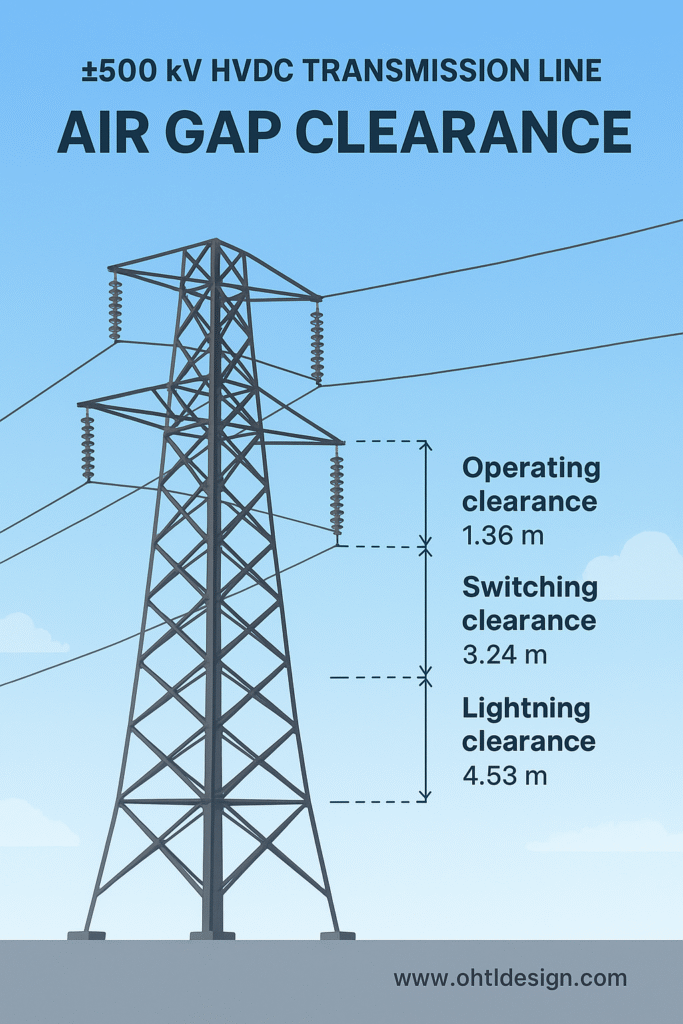
When designing high-voltage transmission lines, one of the most critical design parameters is the air gap clearance — the safe distance between energized conductors and grounded components such as tower arms or insulator fittings.
For any transmission line, air gap clearance ensures system reliability, electrical insulation safety, and compliance with international standards.
This article explains what an air gap is, why it is important, and how to calculate it step by step using simplified formulas based on EN 50341-1, CIGRÉ Brochure 388, and IEC 60071.
1. What Is Air Gap Clearance?
Air gap clearance is the minimum distance through air that must be maintained between parts at different voltages — for example, between a conductor and tower steel.
The purpose is to prevent a flashover, which happens when voltage stress exceeds the insulating strength of air.
In short:
Higher voltage → larger required air gap.
For HVDC systems, this clearance is even more critical because DC voltage is constant and stresses the air continuously, unlike AC which alternates and allows air to recover between cycles.
2. Why Air Gap Clearance Is Important
- Safety – prevents flashovers or electric arcs.
- Reliability – avoids outages during storms or switching events.
- Standard compliance – ensures the design meets IEC and EN requirements.
- Environmental tolerance – accounts for wind, humidity, altitude, and pollution.
3. Standards Used for Air Gap Design
For a ±500 kV HVDC transmission line, the following standards are referenced:
- EN 50341-1 – Overhead line design above 1 kV
- CIGRÉ Brochure 388 – HVDC insulation coordination
- IEC 60071 – Insulation coordination for high-voltage equipment
These standards help determine minimum clearance under:
- Steady-state (operating) voltage
- Switching overvoltage
- Lightning impulse overvoltage
4. Step-by-Step Air Gap Calculations for 500 kV HVDC
4.1 Steady-State (Operating) Voltage Clearance
Step 1 – Given Data
DC operating voltage (each pole):
Udc = ±550 kV (includes 10% design margin above nominal 500 kV)
Step 2 – Convert DC Voltage to Equivalent AC Voltage
Since standards are based on AC, we convert DC to equivalent AC using:
Up = (1.05 × Udc) / 0.816
Where:
- 1.05 is the 5% voltage rise factor
- 0.816 is the conversion factor between DC and AC RMS values
Calculation:
Up = (1.05 × 550) / 0.816 = 707 kV
Equivalent AC voltage = 707 kV
Step 3 – Determine Clearance from EN 50341 Table
According to EN 50341-1, for 765 kV AC the clearance is 1.28 m.
We interpolate for 707 kV using:
Required clearance = 1.28 × (707 / 765)
Required clearance = 1.18 m
Now apply an atmospheric correction factor of 1.15 for altitude and humidity:
Adjusted clearance = 1.18 × 1.15 = 1.36 m
✅ Result:
Operating clearance = 1.36 m (for elevation below 1000 m)
Step 4 – Explanation
This clearance is used under extreme wind conditions when the conductor may swing closer to the tower.
It ensures that even during maximum deflection, no flashover occurs.
Note:
The 765 kV used in the formula is a reference voltage from EN 50341-1 tables — it’s the highest AC voltage level used to interpolate the correct clearance for 707 kV equivalent HVDC.
4.2 Switching Overvoltage Clearance
When breakers open or close, temporary voltage surges can occur — often twice the nominal voltage.
Step 1 – Given Data
Nominal voltage = ±550 kV
Switching overvoltage = 2 × 550 = 1100 kV
Step 2 – Formula from CIGRÉ Brochure 388
d = (1.2 × U / K500) ^ 1.66
Where:
- U = overvoltage (kV)
- K500 = 1.35 (empirical constant for 500 kV level)
Calculation:
d = (1.2 × 1100 / 1.35) ^ 1.66
d ≈ 3.04 m
Other standards give similar values:
- IEC 60071 → 2.72 m
- EN 50341-1 → 3.24 m
✅ Result:
Switching overvoltage clearance = 3.24 m
Step 3 – Explanation
This clearance ensures that even during temporary switching surges, the electric field strength in air remains below breakdown level.
This value applies for reduced-wind conditions (normal weather).
4.3 Lightning Overvoltage Clearance (Still Air)
Lightning strikes create very high short-duration voltage impulses.
The clearance must be large enough to withstand these peaks even in calm (still air) conditions.
Step 1 – Given Data
Equivalent AC voltage = 707 kV
Step 2 – Formula from EN 50341 Table 5.6
Required clearance = 4.90 × (707 / 765)
Calculation:
Required clearance = 4.53 m
✅ Result:
Lightning overvoltage clearance = 4.53 m
(Used for lightning impulse withstand under still air at –1°C)
Step 3 – Explanation
This clearance ensures that even if a lightning impulse reaches the line, the air insulation is strong enough to prevent flashover between conductor and tower steel.
5. Summary of All Clearances
| Type of Overvoltage | Condition | Voltage Level (kV) | Clearance (m) | Reference | Remark |
|---|---|---|---|---|---|
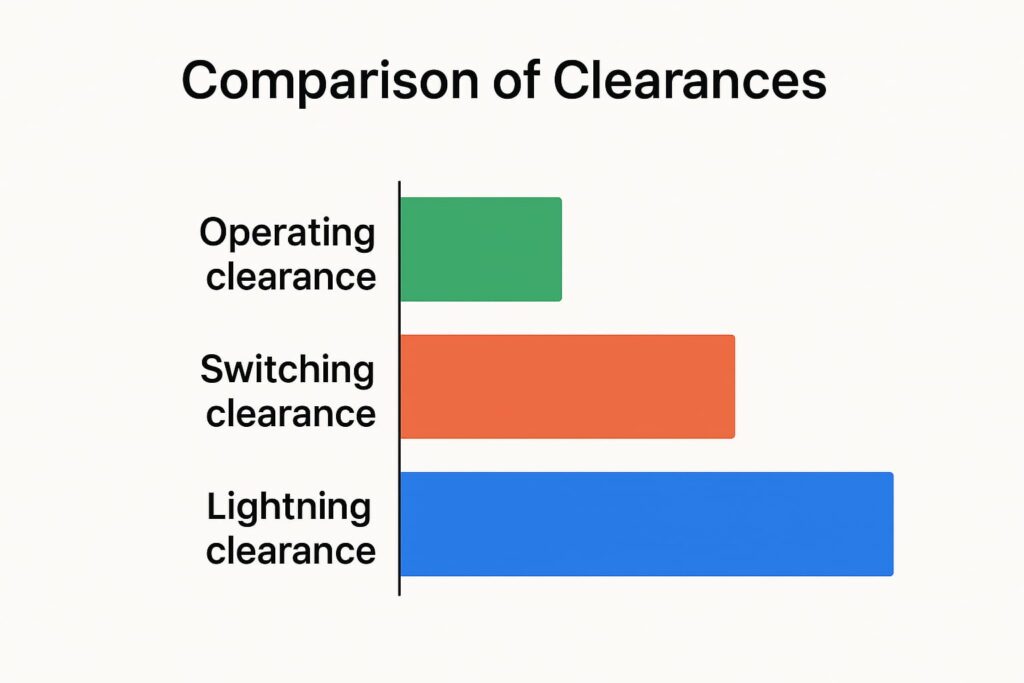
| Operating (steady-state) | Extreme wind | ±550 → 707 eq. | 1.36 | EN 50341-1 | Continuous operation |
| Switching overvoltage | Reduced wind | 1100 | 3.24 | CIGRÉ 388 / IEC 60071 | During switching surges |
| Lightning overvoltage | Still air | Impulse | 4.53 | EN 50341-1 | Lightning impulse withstand |
6. Factors Affecting Air Gap Clearance
- Altitude:
At higher altitude, air is thinner and dielectric strength drops.
Clearance increases by about 10–15% per 1000 m. - Wind Speed:
Conductors swing toward the tower under strong wind.
Different clearances are defined for extreme, reduced, and still air. - Weather and Humidity:
Moist air, fog, or rain reduce breakdown voltage of air. - Pollution Level:
Salt, dust, or industrial pollutants can reduce surface insulation.
Designers coordinate air gap with creepage distance. - Tower Geometry:
The arrangement of cross-arms and insulator strings determines available gap and field strength. - Temperature:
Air density decreases with higher temperature, slightly affecting clearance.
7. Example Summary for ±500 kV HVDC Line
| Step | Parameter | Formula | Result | Meaning |
|---|---|---|---|---|
| 1 | Convert 550 kV DC to AC equivalent | (1.05 × 550) / 0.816 | 707 kV | Equivalent RMS AC |
| 2 | Operating clearance | 1.28 × (707 / 765) × 1.15 | 1.36 m | For continuous operation |
| 3 | Switching clearance | (1.2 × 1100 / 1.35) ^ 1.66 | 3.04 → 3.24 m | For switching surges |
| 4 | Lightning clearance | 4.90 × (707 / 765) | 4.53 m | For impulse withstand |
8. Key Takeaways
- Air gap clearance is essential for insulation safety and reliable operation.
- For ±500 kV HVDC line (altitude below 1000 m):
- Operating clearance: 1.36 m
- Switching overvoltage clearance: 3.24 m
- Lightning clearance: 4.53 m
- Always reference EN 50341-1, CIGRÉ 388, and IEC 60071.
- Consider environment, altitude, and wind for final design.
Conclusion
The air gap clearance design for transmission lines is one of the most important parts of insulation coordination.
By following the right standards and applying correction factors for weather and altitude, engineers can ensure the line remains safe, efficient, and compliant under all conditions.