Transmission Line Insulators: Types, Function, and Importance in Overhead Power Lines
Transmission line insulators are one of the most essential components in overhead power transmission systems. They are designed to support high-voltage conductors and at the same time, prevent the unwanted flow of current to the ground or tower structure. In simple words, insulators keep the line safe, stable, and efficient. Without proper insulation, electricity could leak through the towers, causing flashovers, outages, or even dangerous accidents.
Why Insulators Are Important in Transmission Lines
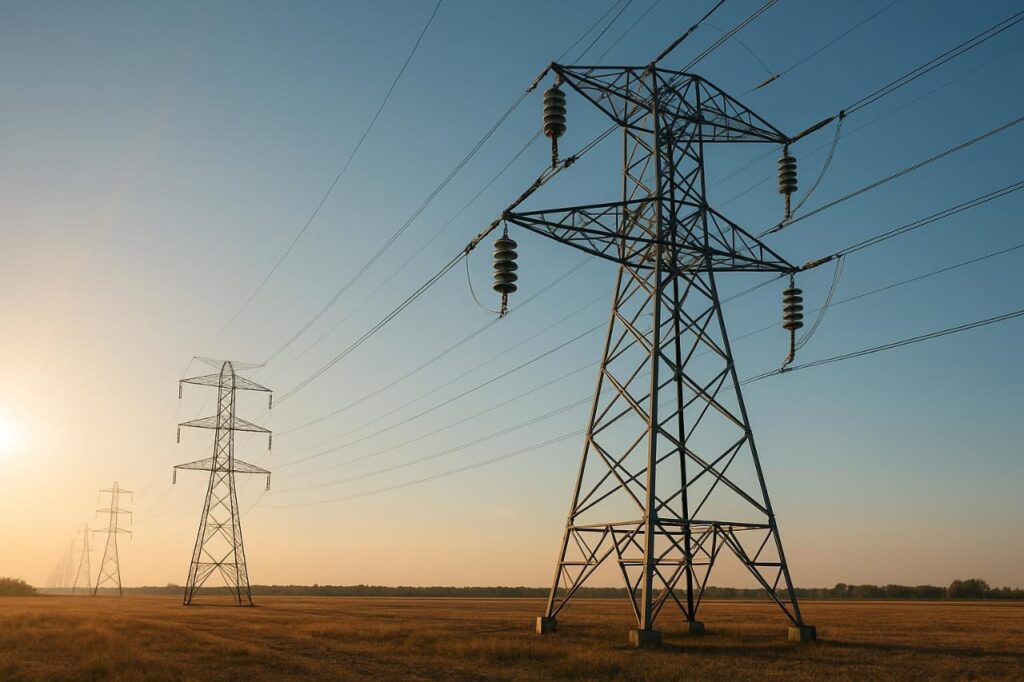
When electricity travels through overhead conductors, it is at a very high voltage — sometimes up to hundreds of kilovolts. These conductors are supported by tall steel towers. If the conductor touches the tower or even comes too close, a high-voltage arc can jump across and cause a fault. To prevent this, insulators are placed between the tower and the live conductor. They act as a barrier that resists current flow, ensuring that electricity remains in the conductor where it belongs.
Besides electrical safety, insulators also play an important mechanical role. They support the heavy weight of conductors, especially over long spans, and must withstand wind loads, vibrations, temperature changes, and environmental conditions such as rain, pollution, or salt in coastal areas.
Key Components of an Overhead Transmission Line
To understand the role of insulators better, let’s briefly look at the main components of an overhead line system:
- Conductors: Carry electrical power from generating stations to substations or consumers.
- Insulators: Provide both mechanical support and electrical isolation between conductors and towers.
- Towers: Hold the conductors at a safe height and spacing above the ground.
- Ground (Shield) Wires: Protect the line from lightning strikes.
- Hardware and Accessories: Include clamps, spacers, dampers, and fittings used to connect or stabilize the line.
Among all these parts, insulators are the silent protectors that maintain electrical safety and reliability every second of operation.
Types of Transmission Line Insulators
Insulators come in different designs depending on voltage level, line design, and environmental conditions. The most common types are explained below in simple words:
1. Pin Type Insulator
This is one of the oldest and simplest types. The insulator is mounted on a steel pin fixed to the cross-arm of the pole or tower. The conductor is tied on top of the insulator. Pin type insulators are used in low- and medium-voltage lines, generally up to 33 kV. For higher voltages, the required length and number of insulators become too large, making them less practical.
2. Suspension Type Insulator
In this type, several porcelain or glass discs are connected in series to form a string. The conductor is attached to the bottom end, and the top end is connected to the tower cross-arm. This design allows the voltage to be distributed across multiple discs, making it suitable for high-voltage lines (66 kV and above). The string can be lengthened or shortened depending on the line voltage.
3. Strain Insulator
At points where the line changes direction or ends at a terminal tower, there is high mechanical tension. Strain insulators are used in such locations to handle the pull of the conductors. They are usually made of multiple suspension discs arranged in a horizontal or V shape.
4. Shackle Insulator
Shackle insulators are often used in low-voltage distribution lines, especially in urban areas. They can be mounted either horizontally or vertically and are made of tough porcelain material.
5. Post Insulator
Post insulators are used in substations and switchyards where they support conductors and busbars. They are designed to carry high mechanical loads and withstand high voltage levels.
Materials Used in Insulator Manufacturing
The performance and durability of insulators depend heavily on the material used. Common materials include:
- Porcelain: The most widely used material. It has excellent mechanical strength and can withstand moisture and temperature variations. Porcelain is made from a mixture of clay, quartz, and feldspar, and then fired at high temperatures to achieve strength and glazing.
- Glass: Offers high dielectric strength and is easy to inspect visually (cracks are visible). However, glass can be brittle and may not perform well in extreme environments.
- Polymer (Composite) Insulators: Made from fiberglass rods covered with silicone rubber or other polymers. They are lightweight, easy to install, and resistant to vandalism. Polymer insulators are now widely used in modern EHV and UHV lines due to their hydrophobic and anti-pollution properties.
Advantages of Polymer Insulators
Polymer insulators have become popular in recent years because they solve many of the issues faced by traditional materials. Below are their main advantages:
- They are much lighter than porcelain or glass, making transportation and installation easier.
- Their surfaces are hydrophobic, which means they repel water and reduce leakage current during rain or fog.
- They perform better in polluted or coastal areas because dirt does not stick easily.
- They resist breakage during handling and are less prone to vandalism.
- They require less maintenance over their lifetime.
However, polymer insulators also have challenges. They can degrade under long-term ultraviolet exposure or corona discharge. That is why quality testing and proper design are very important.
Electrical and Mechanical Stresses on Insulators
Insulators in a transmission line face multiple stresses at the same time:
- Electrical Stress: Due to continuous operating voltage, switching surges, and lightning impulses. Proper creepage distance and voltage distribution are required to avoid flashovers.
- Mechanical Stress: Caused by conductor tension, wind pressure, and the weight of the insulator string.
- Environmental Stress: Due to pollution, salt, fog, ice, UV radiation, and temperature changes. These factors can affect surface performance and lifespan.
Testing and Quality Control
Before installation, every insulator must go through strict testing to ensure reliability. Common tests include:
- Mechanical load test to verify strength under tension.
- Electrical tests like dry and wet flashover voltage tests.
- Temperature cycle test to check performance under hot and cold conditions.
- Hydrophobicity test for polymer insulators to ensure surface water repellency.
Only after passing all these tests can an insulator be used in live transmission lines.
Maintenance of Transmission Line Insulators
Even though insulators are strong and long-lasting, regular inspection is important to avoid failures. Maintenance activities include:
- Cleaning of polluted insulators using water jets or dry cleaning methods.
- Replacing cracked or damaged discs in suspension strings.
- Checking corona rings and fittings for wear or corrosion.
- Thermal scanning to detect hot spots caused by loose connections.
Modern Developments and Future Trends
The power industry is now moving toward smarter and more sustainable solutions. Composite insulators with nano-coatings, self-cleaning surfaces, and advanced hydrophobic materials are being developed. In addition, drones and infrared cameras are being used to inspect transmission lines safely and efficiently without power shutdowns.
New materials also focus on improving resistance to ultraviolet radiation and extending service life in extreme weather conditions. These innovations are making overhead transmission systems more reliable, cost-effective, and environmentally friendly.
Conclusion
Transmission line insulators are vital for safe and reliable power delivery. They isolate high-voltage conductors from grounded structures, support mechanical loads, and resist environmental challenges. Over the years, technology has evolved from heavy porcelain and glass insulators to lightweight, efficient polymer composites. Each type has its benefits and limitations, but together they represent a crucial part of modern power networks.
In short, when you look at a transmission tower, remember that the small-looking discs or rods holding the wires are performing one of the most critical functions — ensuring that electricity flows safely and efficiently across cities and countries.
Author
Engr. Zishan Ahmad — Electrical Engineer specializing in Overhead Transmission Line Design Engineering. Sharing easy-to-understand articles for students and engineers worldwide.