Introduction

In power transmission and substation projects, the stability and reliability of tower foundations are crucial for long-term structural performance. One of the most important factors influencing this stability is soil compaction. Properly compacted soil increases the bearing capacity, minimizes settlement, and ensures that transmission towers remain stable even under heavy wind and dynamic loading conditions.
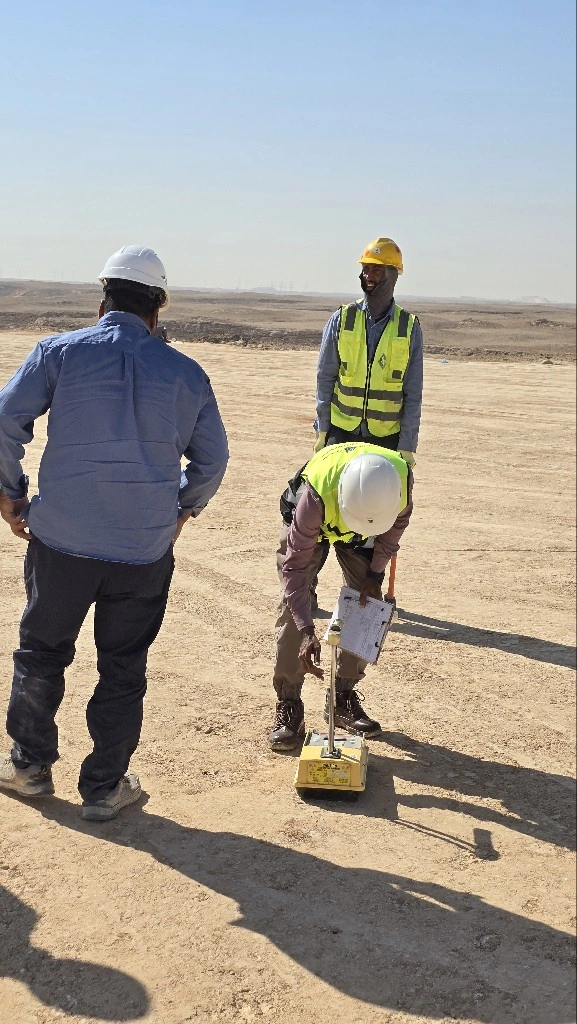
To verify the quality of compaction in the field, the Nuclear Soil Compaction Test—also known as the Nuclear Density Test—is widely used across Saudi Arabia, especially in projects managed by the Saudi Electricity Company (SEC) and its approved contractors. This advanced method provides quick, accurate, and non-destructive measurements of both soil density and moisture content directly at the construction site.
Principle of Operation
The Nuclear Density Gauge works on the principle of radiation interaction with matter, using two types of radioactive sources sealed inside the testing device. These sources emit gamma rays and neutrons that interact differently with soil particles and water molecules.
1. Gamma Source (Cesium-137)
- The gamma source is used to determine the wet and dry density of the soil.
- Gamma rays emitted from Cesium-137 are scattered back to the detector after interacting with soil particles.
- The degree of scattering and absorption helps the device calculate the soil’s density with high precision.
2. Neutron Source (Americium-241/Beryllium)
- The neutron source measures the moisture content of the soil.
- Fast neutrons emitted from Am-241/Be are slowed down when they collide with hydrogen atoms—mainly found in water molecules.
- The detector counts the reflected (thermal) neutrons to determine how much moisture is present within the tested soil.
Together, these two readings—density and moisture content—allow engineers to assess the degree of soil compaction relative to the specified Modified Proctor Maximum Dry Density (MDD).
Application in SEC Transmission Projects
In the Saudi Electricity Company’s transmission tower projects, the nuclear density test plays a vital role during several stages of construction, particularly during backfilling and compaction of:
- Transmission tower foundation excavations
- Cable trenches and duct banks
- Substation yard backfills
- Access and maintenance roads
Importance of Proper Compaction
Proper soil compaction ensures that the foundation can safely bear the structural load of the tower, resist environmental stresses, and minimize long-term maintenance. Specifically, achieving the target compaction:
- Enhances bearing capacity of tower foundations
- Reduces differential settlement under operational loads
- Improves resistance against wind-induced vibration and overturning
- Ensures longevity and safety of transmission and substation structures
Test Procedure (According to ASTM D6938)
The Nuclear Soil Compaction Test follows a standardized procedure as outlined in ASTM D6938 and adopted by SEC Standard 01-SDMS-01 – Earthwork Specification. Below is the typical testing sequence used in the field:
- Surface Preparation:
Clean and level the test area to ensure firm contact between the gauge and soil surface. - Drilling the Test Hole (Direct Transmission Mode):
Use a drilling rod to make a small hole, usually 10–30 cm deep, depending on the required test depth. - Inserting the Probe:
Insert the gauge probe into the pre-drilled hole to the desired depth. - Taking Measurements:
Activate the gauge and take readings for one minute or as per manufacturer recommendations. - Recording Results:
The device automatically displays wet density, dry density, and moisture content. These values are compared with the target compaction ratio derived from the Modified Proctor Test (ASTM D1557). - Evaluation:
Compaction is considered acceptable when the achieved in-situ dry density is equal to or greater than the required percentage of the MDD specified by SEC standards.
SEC Standards and Requirements
The Saudi Electricity Company (SEC) specifies strict guidelines and acceptance criteria for earthwork and compaction testing under its Civil Design Standard 01-SDMS-01. Below are the key requirements:
1. Compaction Criteria
- General Backfill Areas:
Minimum 95% of the Maximum Dry Density (MDD) obtained from the Modified Proctor Test (ASTM D1557). - Critical Zones (Tower and Equipment Foundations):
Minimum 97% of the MDD is required to ensure foundation stability. - Reference and Verification Tests:
- Laboratory test: ASTM D1557 (Modified Proctor).
- Field test: ASTM D6938 (Nuclear Density Gauge).
- Alternative test: ASTM D1556 (Sand Cone Method), used when nuclear testing equipment is not available.
2. Safety and Regulatory Compliance
Because the nuclear gauge contains radioactive materials, its handling is subject to strict safety regulations issued by the National Radiation Regulatory Commission (NRRC) of Saudi Arabia.
Key safety and compliance requirements include:
- Only licensed and trained personnel approved by NRRC are authorized to operate nuclear gauges.
- The device must be stored in lead-shielded containers when not in use.
- A 10-meter exclusion zone should be maintained around the test area for non-authorized individuals.
- Operators must always wear radiation dosimeters and maintain safety logs.
- Emergency and radiation safety procedures must be strictly followed at all times.
3. Calibration and Certification
Accuracy in nuclear testing depends heavily on regular calibration and certification of the gauge. According to SEC and SASO requirements:
- All nuclear gauges must be calibrated annually at laboratories accredited by the Saudi Standards, Metrology, and Quality Organization (SASO) or the SEC Quality Control Division.
- Calibration must comply with ISO/IEC 17025 standards for testing and calibration laboratories.
- Calibration certificates should be verified and kept on-site for inspection.
Advantages of the Nuclear Density Test
The nuclear compaction test offers several advantages that make it ideal for transmission tower and substation projects:
- Fast and Efficient: Results are obtained in just a few minutes, enabling immediate decision-making.
- Accurate and Reliable: Provides precise readings of both moisture and density compared to traditional methods.
- Non-Destructive: No large samples or excavation are required, preserving the integrity of compacted soil layers.
- Quality Control Tool: Ensures that backfilling meets the SEC’s engineering and safety requirements.
- Reduces Rework: Early detection of under-compaction prevents costly re-excavation or structural issues later.
Limitations
Despite its advantages, there are certain limitations and operational restrictions:
- Requires trained and licensed operators under NRRC authorization.
- Unsuitable for saturated or organic soils, as readings may be inconsistent.
- Must be handled and stored with extreme care following radiation safety protocols.
- Equipment costs and regulatory requirements may be higher compared to traditional sand cone testing.
References
- ASTM D6938 – Standard Test Methods for In-Place Density and Water Content of Soil and Soil-Aggregate by Nuclear Methods.
- ASTM D1557 – Standard Test Methods for Laboratory Compaction Characteristics of Soil Using Modified Effort.
- SEC Standard 01-SDMS-01 – Earthwork and Backfilling for Transmission and Substation Projects.
- AASHTO T310 – Density and Moisture Content by Nuclear Method.
- NRRC (KSA) – Radiation Safety Guidelines, 2022.
- SASO ISO 17025 – Testing and Calibration Laboratory Accreditation.
Conclusion
The Nuclear Soil Compaction Test is a critical quality assurance tool in Saudi Electricity Company (SEC) transmission and substation construction projects. By combining advanced nuclear gauge technology with SEC’s engineering standards, project teams can ensure that every tower foundation is built on properly compacted soil, guaranteeing long-term safety and stability.
This testing method not only accelerates project timelines but also reinforces compliance with ASTM, AASHTO, and Saudi regulatory requirements, ensuring that each transmission tower performs reliably under all environmental and operational conditions.
Through consistent application of nuclear testing procedures, rigorous calibration, and strict adherence to NRRC safety guidelines, engineers and contractors can maintain the highest levels of quality control, efficiency, and structural integrity across the Kingdom’s power transmission infrastructure.
ALSO READ: Protective Coating Requirements for OHTL Foundations as per SEC Standards

Eng. Mohamed Essam
Senior Civil Construction Engineer | Infrastructure & OHTL SpecialistNationality: Egyptian
LinkedIn Profile
Eng. Mohamed Essam is a Civil Engineer with over 10 years of experience in the execution and management of infrastructure projects, including substation works and high-voltage transmission lines (OHTL). He is currently leading the execution of a 380 kV Transmission Tower project within the Qiddiya Project in Riyadh, one of the Kingdom’s most prominent national initiatives.
Known for precision in field execution, strong coordination with technical teams, and a solid commitment to the highest standards of quality and safety.