Abstract
Extra High Voltage (EHV) 380 kV Overhead Transmission Lines (OHTL) form the backbone of modern power transmission systems, especially in the Kingdom of Saudi Arabia, where long transmission corridors and high power demand dominate network planning. One of the most critical operational challenges in long EHV OHTL is phase electrical unbalance, caused by the asymmetrical physical arrangement of phase conductors on transmission towers.
To mitigate this issue, the Saudi Electricity Company (SEC) mandates the use of Phase Transposition Towers, among which the F_TR3 Phase Transposition Tower is a standardized and SEC-approved configuration for 380 kV OHTL.
This article presents a detailed technical and structural study of the F_TR3 tower, covering its electrical purpose, structural configuration, design philosophy, loading conditions, insulation requirements, and material specifications, fully aligned with SEC standards. The study highlights the critical role of F_TR3 towers in improving system performance, electrical balance, and long-term reliability of EHV overhead transmission networks.
1. Introduction to 380 kV Overhead Transmission Lines (OHTL)
Overhead Transmission Lines remain the most economical and operationally flexible solution for bulk power transfer over long distances when compared to underground cable systems. For 380 kV EHV systems, design complexity increases significantly due to:
- Long span lengths
- Bundled conductors
- High mechanical loads
- Elevated electric field intensity
In long-distance OHTL, non-symmetrical conductor geometry leads to unequal inductance and capacitance values for each phase. This electrical imbalance can result in:
- Unequal phase voltages and currents
- Increased transmission losses
- Reduced accuracy of protection and metering systems
- Interference with communication circuits
To address these issues, SEC mandates periodic phase transposition along 380 kV routes using dedicated towers such as the F_TR3 Phase Transposition Tower.
2. What Is an F_TR3 Phase Transposition Tower?
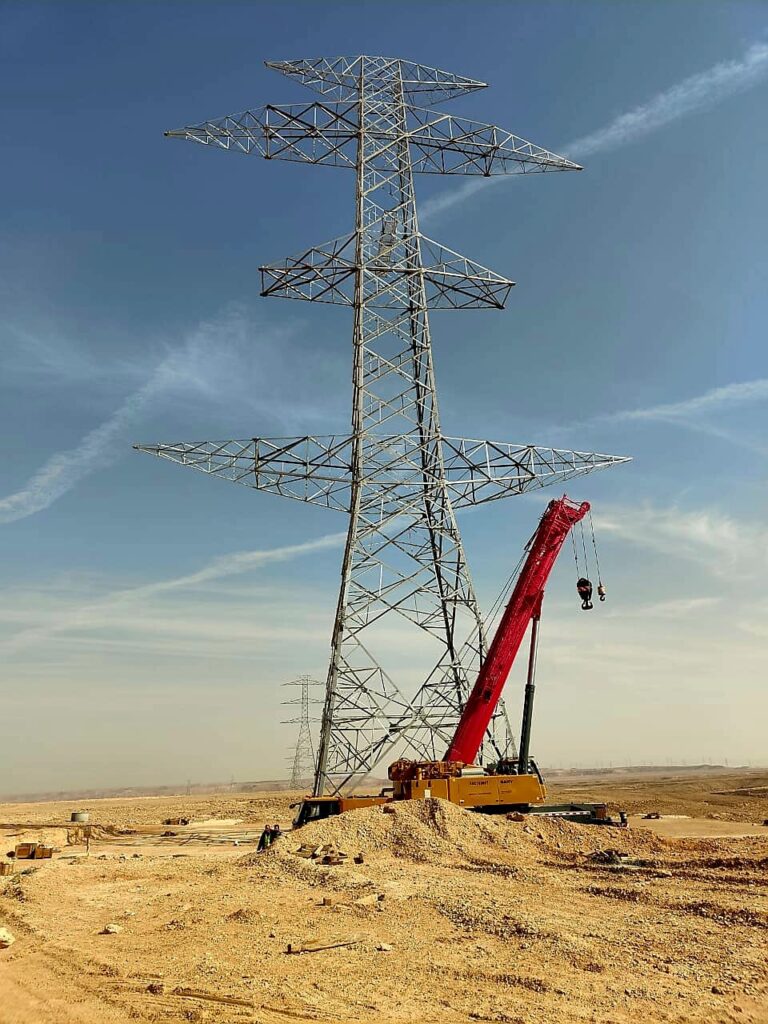
The F_TR3 Phase Transposition Tower is a specialized tower type used in 380 kV OHTL to perform a complete exchange of phase conductor positions along the transmission line.
Unlike conventional suspension or tension towers, the F_TR3 tower features:
- Unique tower geometry
- Specially designed cross arms
- Controlled conductor crossover arrangements
These features allow conductors to cross safely while maintaining required electrical clearances and structural integrity.
Tower Designation Explained
- F – Tower family / functional classification
- TR – Transposition
- 3 – Third SEC-approved standardized transposition configuration
3. Theoretical Basis of Phase Transposition in EHV OHTL
In overhead transmission systems, each phase occupies a different spatial position relative to ground and adjacent phases. This asymmetry creates differences in:
- Self and mutual inductance
- Ground and mutual capacitance
- Overall phase impedance
According to SEC transmission design standards, periodic phase transposition ensures that each phase occupies all physical positions over the total line length, thereby equalizing average electrical parameters.
Key Benefits
- Balanced phase voltages and currents
- Reduced negative sequence components
- Improved system efficiency and reliability
4. Electrical Functions of the F_TR3 Tower
The F_TR3 phase transposition tower performs several critical electrical functions in 380 kV OHTL, including:
- Achieving electrical balance among all three phases
- Improving voltage regulation
- Minimizing phase voltage deviation
- Reducing induced voltages on nearby circuits
- Enhancing Power Line Carrier Communication (PLCC) performance
- Improving protection and metering accuracy
5. Structural Design of the F_TR3 Phase Transposition Tower
5.1 Design Philosophy (SEC Approach)
SEC adopts the Limit State Design (LSD) methodology for all OHTL towers, including F_TR3 towers. The design evaluates:
- Ultimate Limit States
- Serviceability Limit States
- Normal, emergency, and abnormal loading conditions
This approach ensures maximum safety, reliability, and service life.
5.2 Structural System Components
The F_TR3 tower is a lattice steel structure consisting of:
- Main Legs – Carry vertical loads from self-weight, conductors, insulators, and hardware
- Bracing System – Provides lateral stiffness and resists wind and seismic forces
- Transposition Cross Arms – Designed to accommodate conductor crossover and eccentric loading
5.3 Cross-Arm Design for Phase Transposition
Cross arms are the most critical structural elements in F_TR3 towers. Compared to conventional towers, they must:
- Support heavy bundled conductors
- Resist high bending and torsional moments
- Withstand eccentric conductor tensions
- Maintain minimum phase-to-phase and phase-to-ground clearances under all load conditions
6. Design Loads for F_TR3 Towers (As per SEC)
6.1 Vertical Loads
- Self-weight of steel members
- Weight of conductors, insulator strings, and fittings
- Construction and maintenance loads
6.2 Transverse Loads
- Wind loads on conductors and tower body
- Loads due to conductor swing
6.3 Longitudinal & Special Load Cases
- Broken wire condition
- Unequal tension condition
- Stringing condition
These load cases are mandatory for SEC approval of 380 kV phase transposition towers.
7. Insulation System & Electrical Clearances
Due to complex conductor geometry at transposition locations, insulation design is critical. SEC requires:
- Increased insulator string lengths where necessary
- Controlled insulator swing under wind loading
- Full compliance with insulation coordination for 380 kV systems
This ensures safe operation against:
- Switching overvoltages
- Lightning surges
- Corona and radio interference
8. Structural Stability & Analysis Requirements
SEC mandates three-dimensional structural analysis for F_TR3 towers to verify:
- Global stability and overturning resistance
- Member strength and buckling capacity
- Performance at maximum conductor operating temperature
Advanced finite element modeling (FEM) is commonly used to simulate realistic load combinations and boundary conditions.
9. Materials & Corrosion Protection
- High-strength structural steel compliant with SEC specifications
- Hot-dip galvanization for corrosion protection
- Designed service life of minimum 40 years under typical OHTL environmental conditions
10. Integration of Electrical & Structural Design
A defining requirement for F_TR3 towers is the full integration of electrical and structural design. Any structural modification must not compromise:
- Electrical clearances
- Phase geometry
- Overall electrical performance of the OHTL
This integrated approach is strictly reviewed during SEC design approval processes.
11. Conclusion
The F_TR3 Phase Transposition Tower is a vital component in ensuring the balanced, reliable, and efficient operation of 380 kV Overhead Transmission Lines. By combining advanced structural engineering with precise electrical design and strict compliance with SEC standards, F_TR3 towers significantly enhance system performance and long-term network reliability.
For modern EHV transmission networks, proper application and design of phase transposition towers are not optional—they are essential.
12. References (SEC & IEC Approved)
- Saudi Electricity Company (SEC), Transmission Design Criteria for 380 kV OHTL
- SEC, Overhead Transmission Line Standards & Typical Tower Drawings
- SEC, Phase Transposition Requirements for EHV OHTL
- SEC, PLCC Design Guidelines
- IEC 60826 – Design Criteria of Overhead Transmission Lines
- IEC 60071 – Insulation Coordination

Eng. Mohamed Essam
Senior Civil Construction Engineer | Infrastructure & OHTL SpecialistNationality: Egyptian
LinkedIn Profile
Eng. Mohamed Essam is a Civil Engineer with over 10 years of experience in the execution and management of infrastructure projects, including substation works and high-voltage transmission lines (OHTL). He is currently leading the execution of a 380 kV Transmission Tower project within the Qiddiya Project in Riyadh, one of the Kingdom’s most prominent national initiatives.
Known for precision in field execution, strong coordination with technical teams, and a solid commitment to the highest standards of quality and safety.