
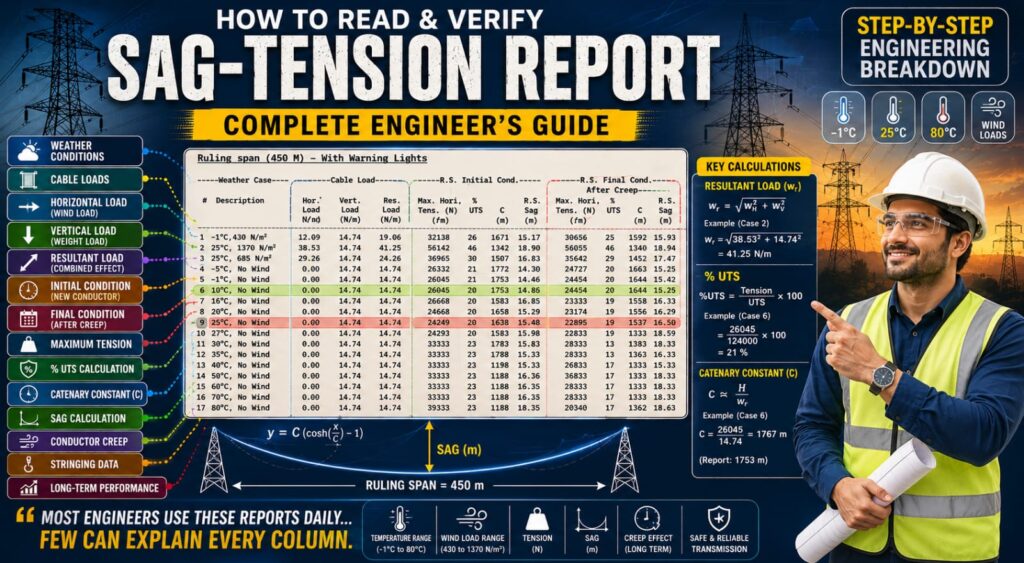
Sag-tension reports are among the most important outputs generated during overhead transmission line design. They provide engineers with the information required to verify conductor behavior under different weather conditions, determine stringing tensions, check clearances, and evaluate long-term performance after creep.
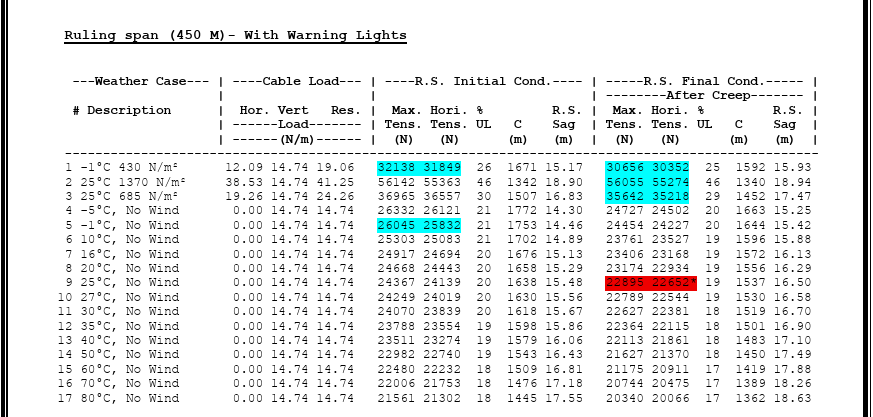
The report shown in above table has been generated for a 450 m ruling span with warning lights attached to the conductor. While many engineers regularly use these reports, understanding the meaning of every column is essential for accurate design verification and construction supervision.
In this article, we will read the report exactly as an engineer would—from left to right—and explain every value using actual examples from the table.
Understanding the Report Layout
The report is divided into four main sections:
- Weather Case
- Cable Load
- Ruling Span Initial Condition
- Ruling Span Final Condition (After Creep)
Before interpreting the results, it is important to understand what these sections represent.
Section 1: Weather Case
The first column identifies the environmental condition under which the conductor is being analyzed.
Examples from the report include:
| Case | Description |
|---|---|
| 1 | -1°C, 430 N/m² Wind |
| 2 | 25°C, 1370 N/m² Wind |
| 3 | 25°C, 685 N/m² Wind |
| 6 | 10°C, No Wind |
| 9 | 25°C, No Wind |
| 17 | 80°C, No Wind |
Each row represents a complete mechanical analysis of the conductor under that specific weather condition.
As weather conditions change, conductor tension and sag also change.
Section 2: Cable Load
The next three columns describe the loads acting on the conductor.
Horizontal Load (N/m)
Horizontal load is mainly produced by wind pressure acting on the conductor.
Consider Case 2:
Horizontal Load = 38.53 N/m
This means every meter of conductor experiences a horizontal wind force of 38.53 Newtons.
Vertical Load (N/m)
Vertical load is primarily the weight of:
- Conductor
- Warning lights
- Fittings and accessories
For Case 2:
Vertical Load = 14.74 N/m
This force acts downward due to gravity.
Resultant Load (N/m)
Since horizontal and vertical loads act simultaneously, the software combines them into a resultant load using vector addition.
Using Case 2:
Horizontal Load = 38.53 N/m
Vertical Load = 14.74 N/m
Resultant Load
= √(38.53² + 14.74²)
= √(1484.56 + 217.27)
= √1701.83
= 41.25 N/m
The report shows:
Resultant Load = 41.25 N/m
which confirms the calculation.
This resultant load is what the conductor actually experiences under the combined action of wind and gravity.
Section 3: Ruling Span Initial Condition
This is the most important section for understanding the behavior of a newly installed conductor.
The term “Initial Condition” refers to the conductor immediately after stringing and before any permanent elongation (creep) has occurred.
At this stage:
- The conductor is new.
- No long-term stretching has taken place.
- Tension is higher.
- Sag is lower.
The columns under Initial Condition describe the conductor behavior at this moment.
Initial Condition Column 1: Maximum Horizontal Tension
Let us use Case 5 (-1°C, No Wind).
The report shows:
Maximum Horizontal Tension = 26,045 N
This means the horizontal component of conductor tension is 26.045 kN.
The value is important because it determines:
- Tower loading
- Insulator loading
- Hardware loading
Higher tension produces larger forces on the supporting structures.
Initial Condition Column : % UTS
UTS means Ultimate Tensile Strength.
It represents the maximum force the conductor can withstand before failure.
The report shows for Case 5:
Horizontal Tension = 25832 N
% UTS = 21%
The percentage is calculated as:
%UTS = (Conductor Tension ÷ Conductor UTS) × 100
Using the report values:
21 = (25832 ÷ UTS) × 100
Therefore:
UTS = 25832 ÷ 0.21
UTS ≈ 123,000 N
≈ 123 kN
Verification:
(25832 ÷ 123000) × 100
≈ 21%
This matches the report.
This column allows engineers to verify that conductor tensions remain within acceptable design limits.
Initial Condition Column 3: C (m)
The next column is labelled “C”.
This is the catenary constant.
It defines the shape of the conductor curve.
For Case 5:
Horizontal Tension = 25832 N
Resultant Load = 14.74 N/m
Approximate Catenary Constant:
C = H ÷ w
C = 25832 ÷ 14.74
C ≈ 1752.51 m
The report shows:
C = 1753 m
The slight difference is due to the exact catenary equations used by PLS-CADD.
The larger the catenary constant, the flatter the conductor profile.
Initial Condition Column 4: R.S. Sag
R.S. stands for Ruling Span.
For Case 5:
R.S. Sag = 14.46 m
This means the conductor sags approximately 14.46 m below the support level in the equivalent ruling span.
This is the sag that would exist immediately after conductor installation.
Section 4: Ruling Span Final Condition (After Creep)
The final section shows the conductor behavior after creep has occurred.
This section is extremely important because transmission lines are expected to remain in service for 30 to 50 years.
During this period, the conductor undergoes permanent elongation known as creep.
As creep occurs:
- Conductor length increases.
- Horizontal tension decreases.
- Sag increases.
The Final Condition columns show the long-term behavior of the conductor.
Comparing Initial and Final Conditions
Let us again examine Case 5.
Initial Condition
Horizontal Tension = 25,832 N
Sag = 14.46 m
Final Condition
Horizontal Tension = 24,227 N
Sag = 15.42 m
Now calculate the change.
Tension Reduction:
25832 − 24227
= 1605 N
Sag Increase:
15.42 − 14.46
= 0.96 m
This clearly shows the effect of conductor creep.
After years of service:
- Tension becomes lower.
- Sag becomes higher.
This is why clearance checks should always be performed using Final Condition values rather than Initial Condition values.
Why Do Engineers Care About Initial and Final Conditions?
Initial Condition is important for:
- Stringing operations
- Installation checks
- Construction verification
Final Condition is important for:
- Ground clearance checks
- Road crossing checks
- Railway crossing checks
- Long-term line safety
The final condition represents how the conductor will behave during most of its operational life.
ALSO READ: Do You Know What Ground Clearance Is and Why It’s Important in Overhead Transmission Lines?
What Does This Report Tell Us?
Reading the report from left to right allows engineers to understand the complete mechanical behavior of the conductor.
The Weather Case defines the environmental condition.
The Cable Load section defines the forces acting on the conductor.
The Initial Condition section shows the behavior of a newly installed conductor.
The Final Condition section shows the behavior after years of service and creep.
By understanding each column and verifying the calculations, engineers can confidently use sag-tension reports for conductor stringing, clearance verification, tower design, and long-term transmission line reliability.
Author’s Bio
Zishan Ahmad
Transmission Line Design Engineer | PLS-CADD | Design Coordinator | OHTL Professional | B.Tech in Electrical & Electronics Engineering
 Connect on LinkedIn
Pingback: Do You Know What Ground Clearance Is and Why It’s Important in Overhead Transmission Lines? - ohtldesign.com