𝐇𝐢𝐠𝐡 𝐕𝐨𝐥𝐭𝐚𝐠𝐞 𝐃𝐢𝐫𝐞𝐜𝐭 𝐂𝐮𝐫𝐫𝐞𝐧𝐭 (𝐇𝐕𝐃𝐂) 𝐭𝐫𝐚𝐧𝐬𝐦𝐢𝐬𝐬𝐢𝐨𝐧 𝐭𝐞𝐜𝐡𝐧𝐨𝐥𝐨𝐠𝐲 𝐢𝐬 𝐢𝐧𝐜𝐫𝐞𝐚𝐬𝐢𝐧𝐠𝐥𝐲 𝐮𝐬𝐞𝐝 𝐢𝐧 𝐦𝐨𝐝𝐞𝐫𝐧 𝐩𝐨𝐰𝐞𝐫 𝐬𝐲𝐬𝐭𝐞𝐦𝐬 𝐟𝐨𝐫 𝐥𝐨𝐧𝐠-𝐝𝐢𝐬𝐭𝐚𝐧𝐜𝐞 𝐛𝐮𝐥𝐤 𝐩𝐨𝐰𝐞𝐫 𝐭𝐫𝐚𝐧𝐬𝐟𝐞𝐫, 𝐢𝐦𝐩𝐫𝐨𝐯𝐞𝐝 𝐞𝐟𝐟𝐢𝐜𝐢𝐞𝐧𝐜𝐲, 𝐚𝐧𝐝 𝐠𝐫𝐢𝐝 𝐢𝐧𝐭𝐞𝐫𝐜𝐨𝐧𝐧𝐞𝐜𝐭𝐢𝐨𝐧𝐬.
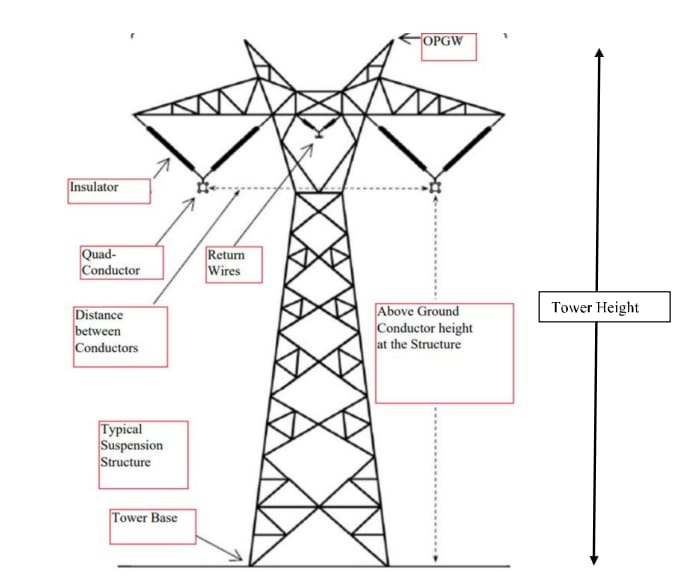
The image below depicts a typical HVDC overhead transmission line suspension tower and its key components.
Optical Ground Wire (OPGW)
Located at the top of the tower, the OPGW serves a dual function:
Grounding: Protects the line from lightning strikes by safely directing fault currents to the ground.
Communication: Houses optical fibers for data transmission between substations, enabling monitoring, control, and protection.
- Insulators
Insulators suspend the conductors and electrically isolate them from the tower body. In HVDC systems, insulators must withstand high direct voltage stress and be designed to prevent leakage currents and flashovers, especially in polluted or coastal environments.
- Quad-Conductors
HVDC lines often use bundle conductors (quad configuration in this case) to reduce corona discharge losses, radio interference, and line reactance. Bundling increases the effective conductor diameter without significantly increasing weight.
- Return Wires
In certain HVDC systems, especially in monopolar configurations, return wires are used to complete the circuit, either through metallic return conductors or via the earth return path.
- Distance Between Conductors
Adequate phase-to-phase and phase-to-ground clearance is essential to:
Prevent flashovers.
Minimize electromagnetic interference.
Maintain safety margins under various weather conditions.
- Above Ground Conductor Height
The conductor height above the ground at the structure ensures:
Compliance with electrical clearance standards.
Safe passage of vehicles, people, and equipment beneath the line.
Minimal risk from induced voltages in nearby metallic structures.
- Typical Suspension Structure
Suspension towers support conductors between long spans without changing the direction of the line. They are designed to carry vertical loads from the conductors and insulators but minimal longitudinal tension.
- Tower Base
The foundation or base transfers all mechanical loads from the tower into the ground. Its design depends on soil conditions, tower weight, wind loading, and seismic considerations. - Tower Height
Determined by required ground clearance, conductor sag, insulation length, and OPGW position, the height of HVDC towers can vary significantly depending on terrain and voltage level.
Importance of HVDC Transmission Towers
HVDC overhead transmission line towers are a crucial part of the power grid, offering:
Reduced transmission losses over long distances.
Improved stability in asynchronous grid connections.
Efficient integration of remote renewable energy sources like hydro, wind, and solar farms.


Pingback: Overhead Transmission Line Towers: Types & Uses - ohtldesign.com Overhead Transmission Line Towers: Types & Uses
Pingback: Sag and Tension Calculation in Overhead Transmission Lines – Complete Guide with Shielding Angle Concept - ohtldesign.com Sag and Tension Calculation – Transmission Lines | OHTL Design
Good article about HVDC towers and their parts. The information about insulators and quad-conductors is helpful.
I also wrote about HVDC systems on my website at https://www.substationfaults.com/hvdc-lcc-classic-system/. I explain how classic HVDC systems work. Your article and mine cover different parts of HVDC technology, so they work well together.
Thank you for sharing this clear information about transmission towers.