
Introduction
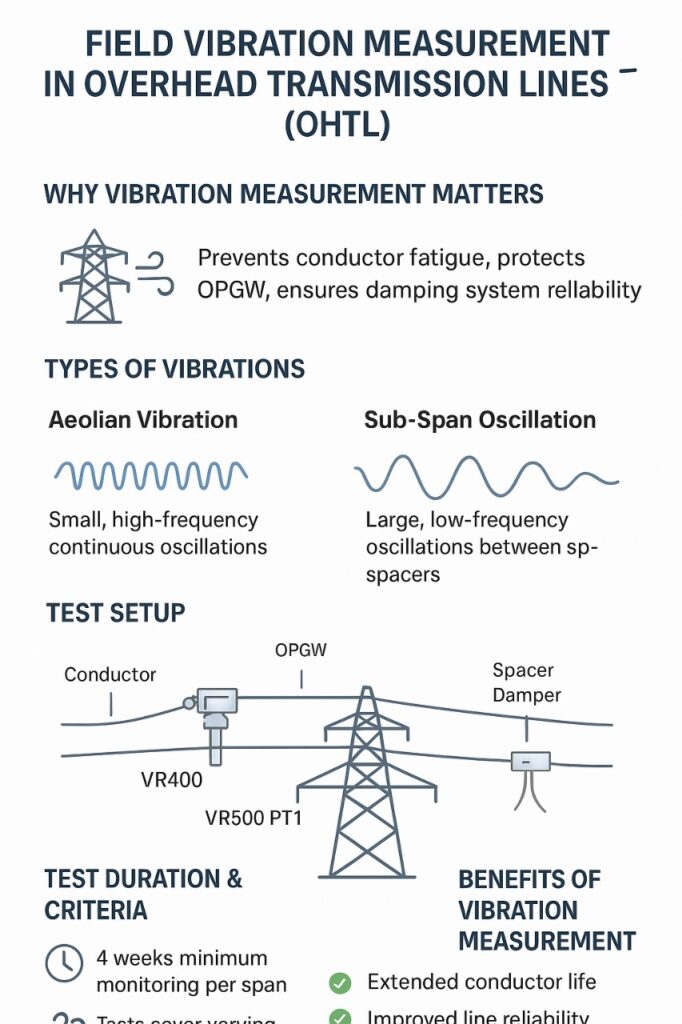
Overhead Transmission Lines (OHTL) are constantly exposed to natural wind, which can induce Aeolian vibrations and sub-span oscillations on conductors and Optical Ground Wire (OPGW). If uncontrolled, these vibrations may cause conductor fatigue, clamp loosening, spacer damage, or OPGW breakage.
To ensure system reliability, utilities conduct field vibration measurements in accordance with international standards such as IEEE Std. 1368 and transmission line specifications.
This article presents a method of statement for field vibration measurement in OHTL, covering the objectives, equipment, setup, procedures, and acceptance criteria.
Objective of Field Vibration Measurement
The main purpose of vibration measurement is to verify the performance of damping systems such as spacer dampers (for bundled conductors) and Stockbridge dampers (for OPGW).
The tests confirm that:
- Aeolian vibrations remain within safe limits of bending strain.
- Sub-span oscillations are effectively damped to acceptable amplitudes.
- Installed damping devices can withstand varying wind speeds and environmental conditions.
Test Locations and Selection Criteria
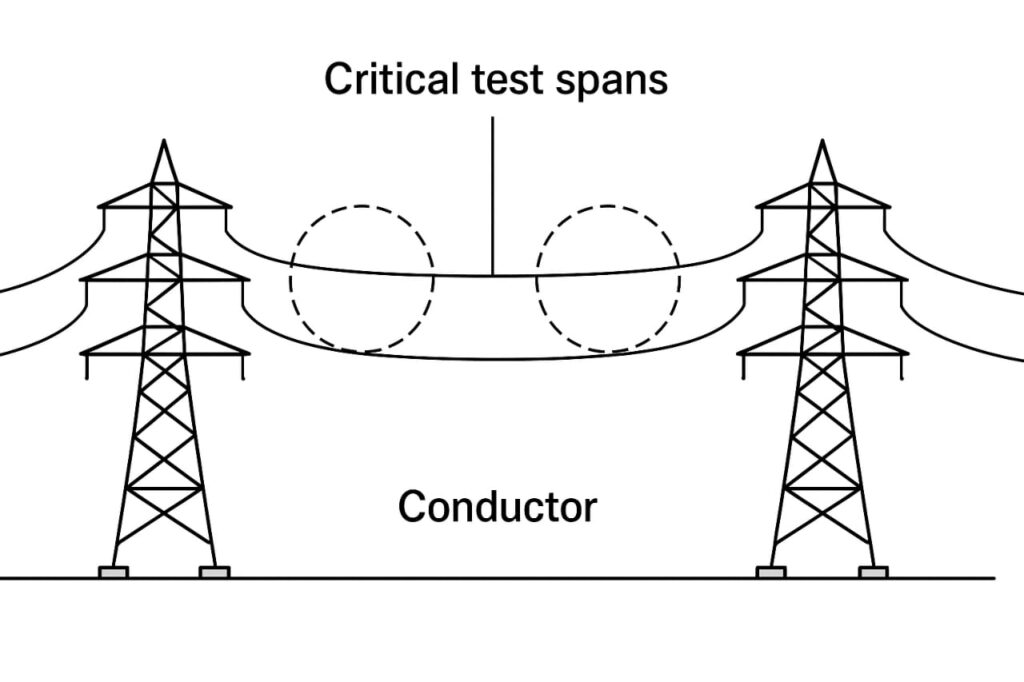
Field vibration measurements are carried out on critical spans of overhead transmission lines. Typically, test spans are chosen based on:
- Long suspension-to-suspension spans (most vulnerable to vibration).
- Spans located in open terrain with no shielding obstacles such as trees or buildings.
- Exposure to prevailing wind direction at right angles to the line.
Test Duration
- Vibration measurements are conducted for a minimum of four weeks at each selected location.
- Continuous monitoring ensures data covers different wind speeds, directions, and climatic variations.
Testing Equipment
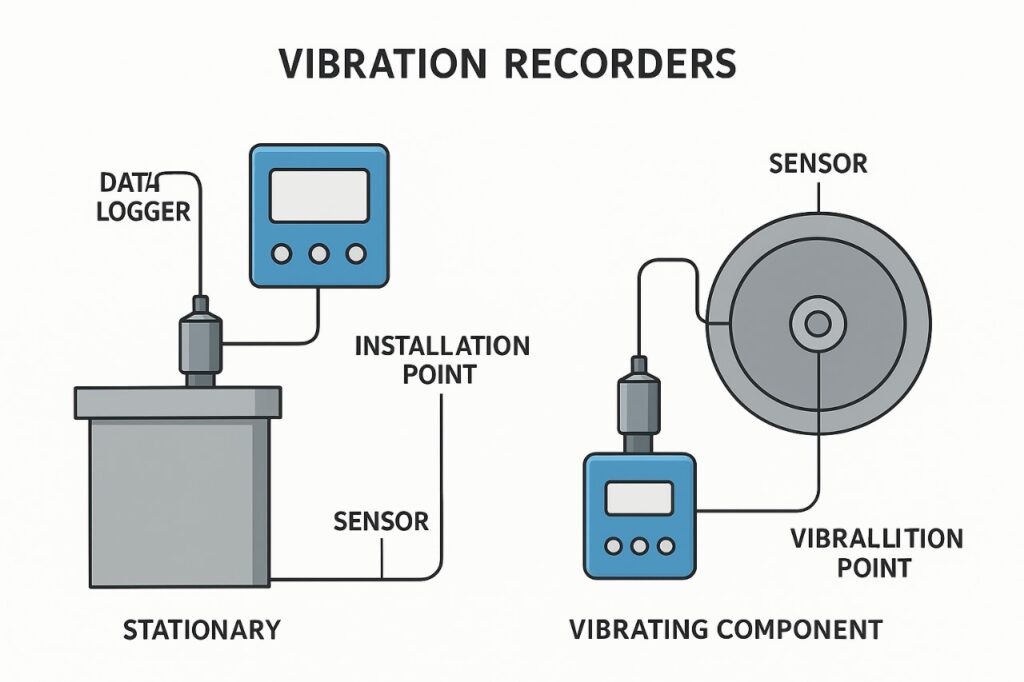
Advanced vibration recorders are used to capture amplitude, frequency, and wind correlation. Typical equipment includes:
ALSO READ:https://ohtldesign.com/how-to-assemble-opgw-accessories-on-terminal-towers/
- Aeolian Vibration Recorder (e.g., VIBREC VR400)
- Measures bending amplitude and frequency (0.2 – 200 Hz).
- Records wind speed (0 – 40 m/s) and ambient temperature (-40°C to +80°C).
- Data analyzed using specialized software with FFT (Fast Fourier Transformation).
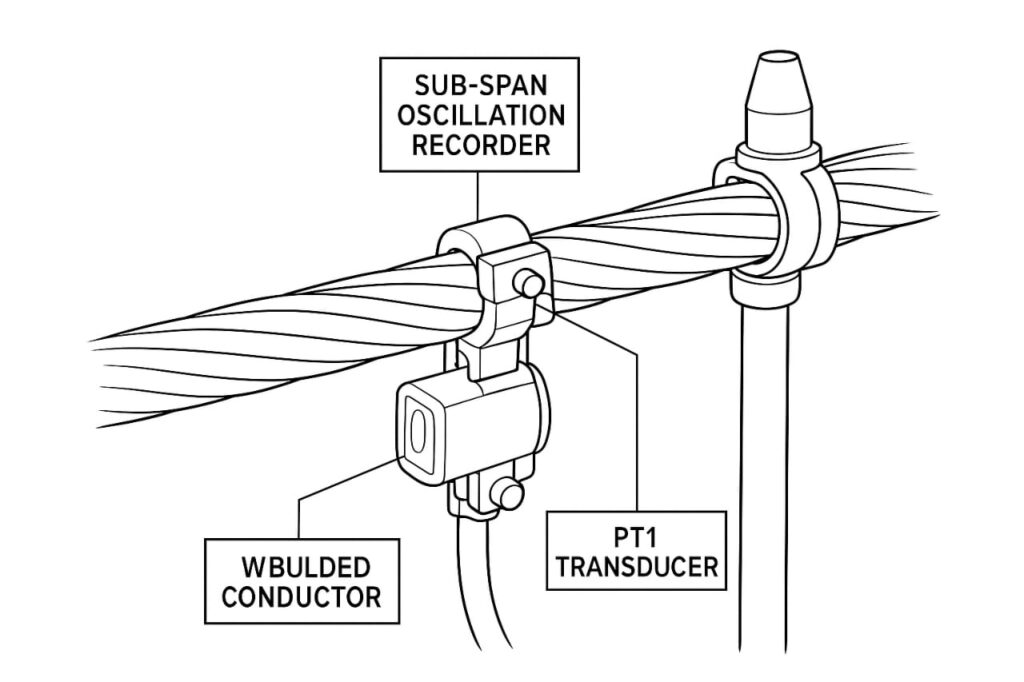
- Sub-Span Oscillation Recorder (e.g., VIBREC VR500 PT1)
- Records oscillation amplitude and displacement.
- Programmable measurement intervals (15 sec to 1 hr).
- Data transfer via USB or wireless with dedicated software.
Testing Setup
Aeolian Vibration Measurement
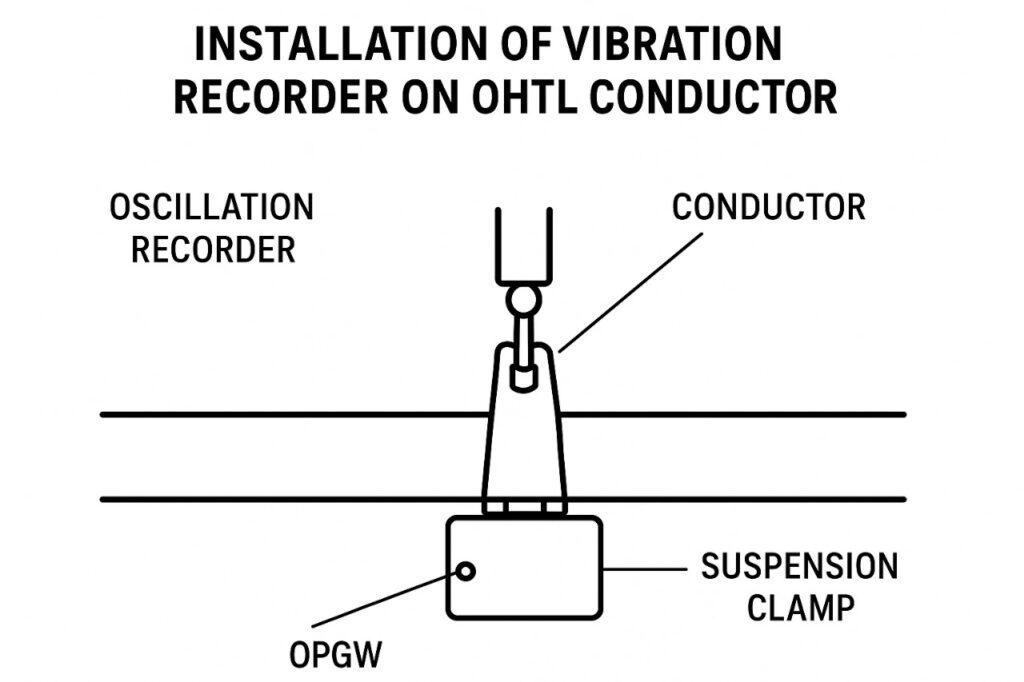
- Recorder installed on the outer sub-conductor of the bundle.
- Sensor tip positioned near the suspension clamp to capture maximum bending strain.
- For OPGW, the recorder is installed at the first armor rod contact point on the clamp.
📸
Sub-Span Oscillation Measurement
- Recorder mounted on the central frame of the spacer damper.
- A transducer installed on the bottom sub-conductor at ¼ of the sub-span length.
- The opposite clamp aligned to ensure proper perpendicular measurement.
Data Evaluation and Acceptance Criteria
- Collected data is processed to analyze frequency, amplitude, wind correlation, and vibration modes.
- Fourier analysis is used to identify dominating vibration frequencies.
- Acceptable vibration limits are generally:
- Conductor Aeolian vibration: ≤200 micro-strains bending strain.
- OPGW vibration: ≤150 micro-strains bending strain.
- Sub-span oscillations: ≤150 mm amplitude (peak-to-peak).
Compliance ensures damping devices are effective and line components remain safe under varying conditions.
Conclusion
Field vibration measurement in Overhead Transmission Lines is an essential quality assurance process. By validating the effectiveness of spacer dampers and Stockbridge dampers, utilities can:
- Prevent premature conductor fatigue.
- Enhance the reliability of OPGW.
- Extend the service life of 500kV and higher voltage transmission lines.
This method of statement for field vibration measurement in OHTL ensures that every stage of monitoring follows international best practices, delivering safe and reliable power transmission.


Pingback: Obstruction Marking and Lighting in Power Transmission - ohtldesign.com