Introduction
Transmission line towers are critical components of electrical power transmission systems. Their primary function is to support overhead conductors while maintaining required electrical clearances, mechanical strength, and system reliability. The selection of an appropriate transmission tower type depends largely on terrain conditions, line deviation angle, voltage level, span length, and mechanical loading.
Utilities such as SEC (Saudi Electricity Company) classify transmission towers based on angle of deviation and application, ensuring safety, reliability, and cost efficiency. This article provides a comprehensive and detailed explanation of all major types of transmission line towers, their deviation angle limits, voltage applicability, and engineering considerations.
Factors Affecting Selection of Transmission Line Towers
Before discussing tower types, it is important to understand the key parameters influencing tower selection:
- Angle of line deviation
- Transmission voltage level (69 kV to 380 kV)
- Terrain profile (plain, mountainous, river crossing, urban areas)
- Span length and ruling span
- Wind, ice, and mechanical loading
- Reliability and cascade failure prevention
Classification of Transmission Line Towers
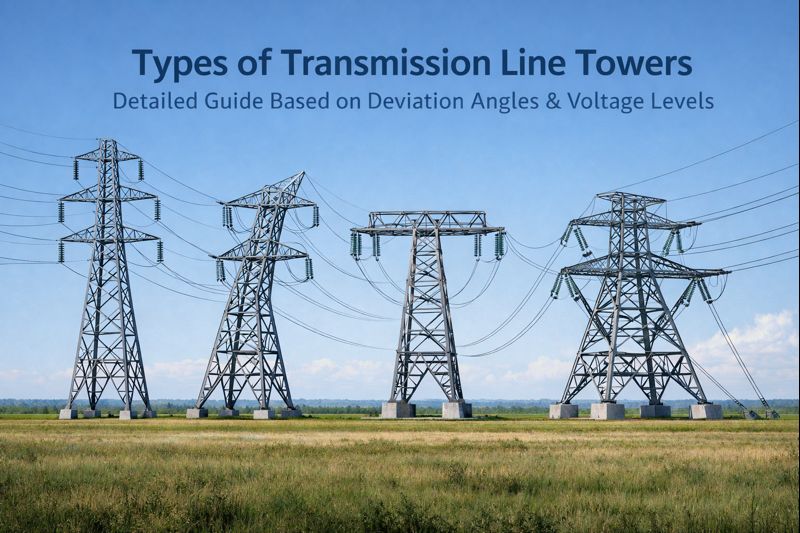
Transmission towers are broadly classified based on line deviation angle and structural loading. The major types used in KSA transmission lines include:
1. Tangent Towers with Suspension Strings
Description
Tangent towers are the most commonly used towers along straight sections of a transmission line. They support conductors using suspension insulator strings, allowing the conductor to swing freely under wind and thermal expansion.
Deviation Angle Range
- 0° to 3° for 69 kV to 230 kV
- 0° to 2° for 380 kV
Key Features
- Economical and lightweight
- Designed primarily for vertical loads
- Limited resistance to longitudinal tension
- Used only up to maximum design wind span
Applications
- Straight-line routes
- Flat or gently undulating terrain
- Long stretches without direction change
2. Small Angle Towers with Tension Strings
Description
Small angle towers are designed to handle minor line deviations and use tension (strain) insulator strings to resist longitudinal conductor forces.
Deviation Angle Range
- 2° to 10° for 69 kV to 230 kV
Key Features
- Increased mechanical strength compared to tangent towers
- Can resist limited unbalanced conductor tension
- Suitable for moderate route deviations
Applications
- Slight bends in transmission alignment
- Terrain transitions
- Wind-exposed areas requiring better stability
ALSO READ: PLS-CADD for Beginners: Complete Introduction to Overhead Line Design Software
3. Light Angle Towers with Tension Strings
Description
Light angle towers handle moderate deviations and are designed to withstand higher longitudinal loads than small angle towers.
Deviation Angle Range
- 10° to 30° for 69 kV to 230 kV
- 2° to 10° for 380 kV
Key Features
- Stronger foundations than small angle towers
- Higher safety margin against conductor tension
- Improved reliability under wind loading
Applications
- Rolling terrain
- Medium route deviations
- Sections with increased mechanical stress
4. Medium Angle Towers with Tension Strings
Description
Medium angle towers are robust structures designed for significant line deviation and increased mechanical forces.
Deviation Angle Range
- 30° to 45° for 69 kV to 230 kV
- 10° to 35° for 380 kV
Key Features
- Heavy-duty structural members
- Designed for large transverse and longitudinal loads
- Requires stronger foundations
Applications
- Hilly or mountainous terrain
- Major changes in line direction
- Areas with high wind speeds
5. Large Angle Towers with Tension Strings
Description
Large angle towers are used where sharp direction changes occur and where conductor tension forces are extremely high.
Deviation Angle Range
- 45° to 60° for 69 kV to 230 kV
- 35° to 60° for 380 kV
Key Features
- Very high mechanical strength
- Designed to prevent structural failure during extreme loading
- Increased construction and foundation cost
Applications
- Sharp turns in transmission routes
- Mountain passes
- Restricted right-of-way areas
6. Heavy Angle Towers with Tension Strings
Description
Heavy angle towers are designed for extreme deviations and act as highly reinforced support structures.
Deviation Angle Range
- 60° to 90° for 69 kV to 380 kV
Key Features
- Maximum load-carrying capacity
- Designed for worst-case loading conditions
- Very strong foundations and bracing
Applications
- Near-right-angle route changes
- Special terrain constraints
- Critical network nodes
7. Anchor Towers with Tension Strings
Description
Anchor towers are special-purpose towers used to sectionalize transmission lines to prevent cascade failures.
Deviation Angle Range
- 0° to 3° for 69 kV to 380 kV
Key Features
- Designed to terminate conductor tension on both sides
- Acts as a mechanical barrier against progressive collapse
- Often placed at regular intervals
Applications
- Long transmission corridors
- High reliability zones
- Strategic network segmentation
8. Dead-End / Terminal Towers with Tension Strings
Description
Dead-end towers terminate transmission lines at substations or switching stations. They are designed to withstand full conductor tension.
Angle of Entry / Take-Off
- 0° to 30° for 69 kV to 380 kV
Key Features
- Designed for both maximum and minimum entry angles
- Highest longitudinal load capacity
- Often equipped with multiple strain insulators
Applications
- Line terminations
- Substations
- Power plant interconnections
9. Transposition Towers with Tension Strings
Description
Transposition towers allow phase conductor transposition, which improves system balance and reduces electromagnetic interference.
Deviation Angle Range
- 0° to 2° for 69 kV to 380 kV
Key Features
- Special cross-arm geometry
- Maintains phase spacing and clearances
- Designed with tension strings for stability
Applications
- Long EHV/UHV transmission lines
- Power quality optimization
- System impedance balancing
Design Notes and Engineering Considerations
1. Design Span and Angle Optimization
- Deviation angles apply to the design ruling span
- Span length may be increased by reducing deviation angle
- All such modifications require SEC approval
2. Safety Factors
- Minimum factor of safety = 2.0
- Applies to:
- Insulators
- Hardware fittings
- Tower members
- Must be verified under worst-case loading conditions
3. Dead-End Tower Design
- Must be designed for both maximum and minimum entry angles
- Ensures reliability under all operational scenarios
4. Tangent Tower Limitations
- Used only up to maximum design wind span
- Longer spans require special tower designs
- Adequate phase-to-phase and phase-to-ground clearances must be maintained
Conclusion
The correct selection of transmission line tower types is essential for system safety, mechanical reliability, and cost-effective operation. By classifying towers based on deviation angle and voltage level, utilities like SEC ensure optimized performance across diverse terrains and operating conditions.
Understanding the technical role of each tower type—from tangent towers to heavy angle and dead-end towers—allows engineers to design transmission lines that meet both electrical and mechanical standards, while minimizing risk and maintenance costs.
🔹 PLS CADD Training (Online)
🚀 Master PLS CADD – Professional Online Training (OHTL Design Focused)
Upgrade your skills in Overhead Transmission Line (OHTL) design with this practical, industry-oriented PLS CADD training.
Designed for beginners, design engineers, and working professionals.
🔑 Topics Covered:
✔️ Basic OHL Concepts
✔️ Sag & Tension Concepts
✔️ Introduction to PLS CADD
✔️ Import Survey & Feature Code Data
✔️ Terrain Width
✔️ Wire & Stick Modelling
✔️ Load Criteria (M1)
✔️ Tower Spotting
✔️ Stringing Charts
✔️ Wind & Weight Span Reports
✔️ Plan & Profile Drawings
✔️ Sag & Tension Calculation using PLS CADD Lite
💰 Course Fee: USD 1300 per participant
🎯 Ideal for transmission line engineers, EPC professionals & fresh graduates.
📌 Training referred & supported by OHTL Design
👉 Connect us on WhatsApp for enrollment:
https://lnkd.in/dQeHFmXR


