
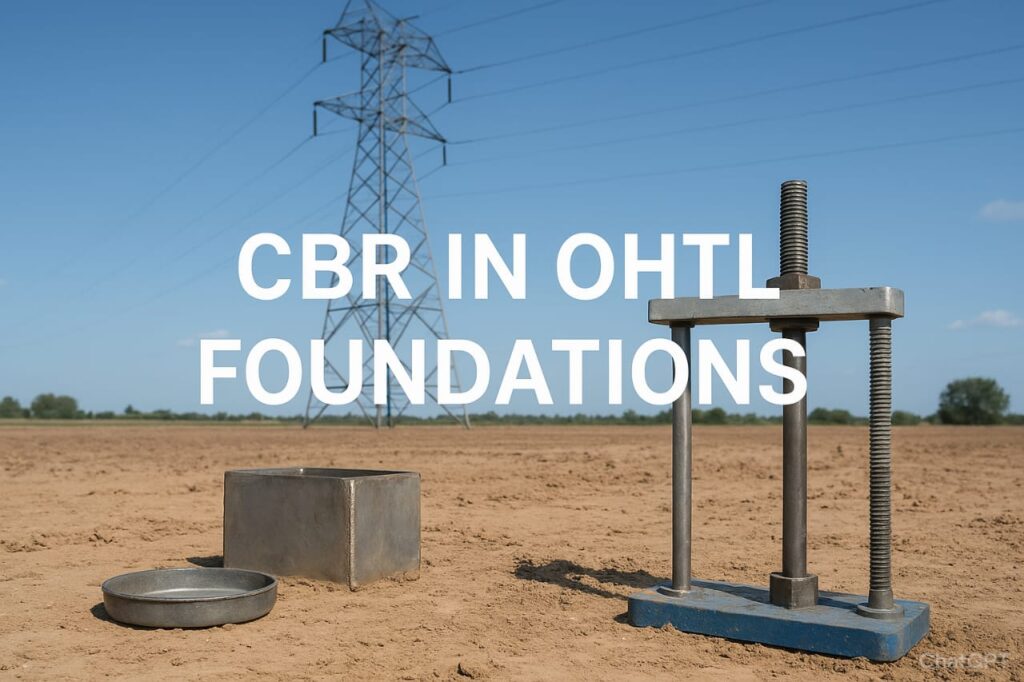
Understanding California Bearing Ratio (CBR) in Overhead Transmission Line Projects
When designing overhead transmission lines (OHTLs), one of the most critical steps is ensuring the soil can safely bear the load of transmission tower foundations. The California Bearing Ratio (CBR) test is a widely used method to evaluate this.
What is CBR?
CBR stands for California Bearing Ratio — a test that measures how much pressure soil can withstand. It compares the load-bearing capacity of site soil with that of standard crushed stone. The result is shown as a percentage.
- Higher CBR = Stronger soil
- Lower CBR = Weak or soft ground
Why is CBR Important for OHTL Foundations?
OHTL towers are often constructed across varied terrain — rocky hills, clay zones, loose sands, etc. The CBR value helps engineers decide:
- If the soil can support the tower
- Whether ground improvement is needed
- Which type of foundation (pad, pile, raft) to use
CBR Value Guide (General):
| CBR Value | Soil Strength | Recommended Action |
|---|---|---|
| < 3% | Very weak | Soil replacement or deep foundation |
| 3–5% | Poor | Ground improvement needed |
| 5–10% | Moderate | May be used with shallow foundations |
| >10% | Strong | Suitable for most foundation types |
Lab CBR vs. Field CBR
- Lab CBR is performed on compacted samples in controlled settings.
- Field CBR is done on actual site soil and reflects true ground conditions — more relevant for OHTL construction.
What Happens If CBR is Low?
- Foundations may fail due to settlement
- Structures may tilt or collapse
- Additional design changes, soil stabilization, or costlier foundations may be needed
Conclusion
The California Bearing Ratio (CBR) may seem like a simple number, but in OHTL design, it speaks volumes. Understanding your soil’s strength through this test ensures safe, long-lasting, and cost-effective tower foundations.
Before finalizing any tower location, make sure the CBR is tested — it’s a small step with big impact.


Thanks for sharing
Informative
Pingback: Structure Pads for Transmission Towers: Design, Criteria, and Dimensions - ohtldesign.com