
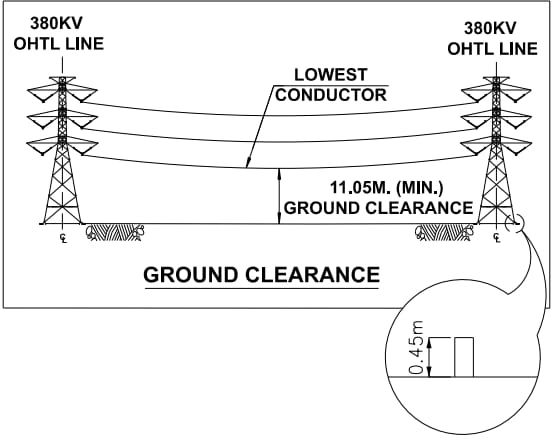
Ground clearance is the vertical distance between the lowest point of a transmission line conductor and the surface of the ground directly below it.
It ensures public safety, prevents electrical flashovers, allows for vehicle and equipment movement, and provides sufficient space for maintenance activities.
In 380 kV Overhead Transmission Line (OHTL) design, especially in Saudi Arabia and Middle Eastern regions, specific design conditions are applied to determine the minimum required vertical clearance.
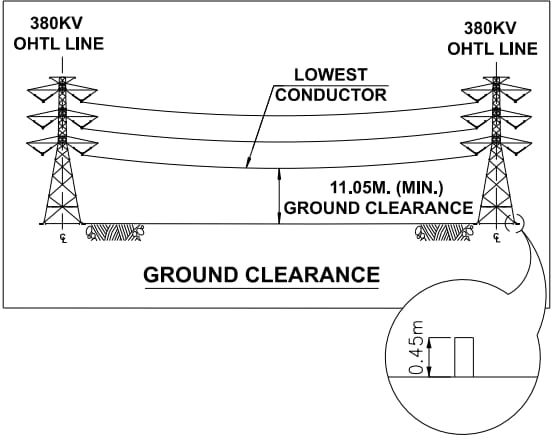
Below are the standard design conditions:
Case 1: Open Terrain / Desert Areas
For 380 kV transmission lines located in open terrain or desert regions, the minimum vertical clearance shall be 10.0 meters, with an additional 0.6-meter margin for plotting profile error, making the total 10.6 meters.
This excludes the concrete foundation height of 0.45 meters.
Case 2: Proximity to Cities, Towns, or Villages
When the transmission line is located in open terrain within 15 km and 5 km from the boundary line of metropolitan cities and other cities/towns/villages, respectively, an additional 5.0 meters clearance shall be added.
Thus, the total clearance becomes 15.6 meters, and including the 0.45-meter foundation, it becomes 16.05 meters.
Case 3: Desert Areas Affected by Shifting Sand Dunes
When the transmission line passes through desert areas affected by shifting sand dunes, the overall clearance shall be increased by 2.0 meters to ensure long-term safety and maintain required separation from the ground.
Case 4: Elevated Locations
When transmission lines are located at higher ground elevations, the vertical clearance shall be adjusted as follows:
3% increase for elevations between 1000 m and 1300 m.
6% increase for elevations between 1300 m and 1600 m.
Example:
Suppose two transmission lines are spotted at ground elevations:
T1: 1025.41 m
T2: 1035.92 m
Since both are above 1000 m, a 3% increase applies to the fixed clearance of 10.0 m (excluding the 0.6 m margin).
3% of 10.0 m = 0.3 m
Hence, the total clearance will be:
10.0 (fixed) + 0.6 (margin) + 0.3 (3% increase) + 0.45 (foundation) = 11.35 m
If elevation exceeds 1300 m, a 6% increase shall be applied instead, adding 0.6 m to the clearance.
💡 Note:
These design parameters are commonly adopted in Saudi Arabia and other Middle Eastern countries as standard practice for 380 kV overhead transmission line design.
ALSO READ: How to Read a Sag-Tension Report: Step-by-Step Explanation of Every Column Using Actual Calculations
Author’s Bio
Zishan Ahmad
Transmission Line Design Engineer | PLS-CADD | Design Coordinator | OHTL Professional | B.Tech in Electrical & Electronics Engineering
 Connect on LinkedIn