
Abstract
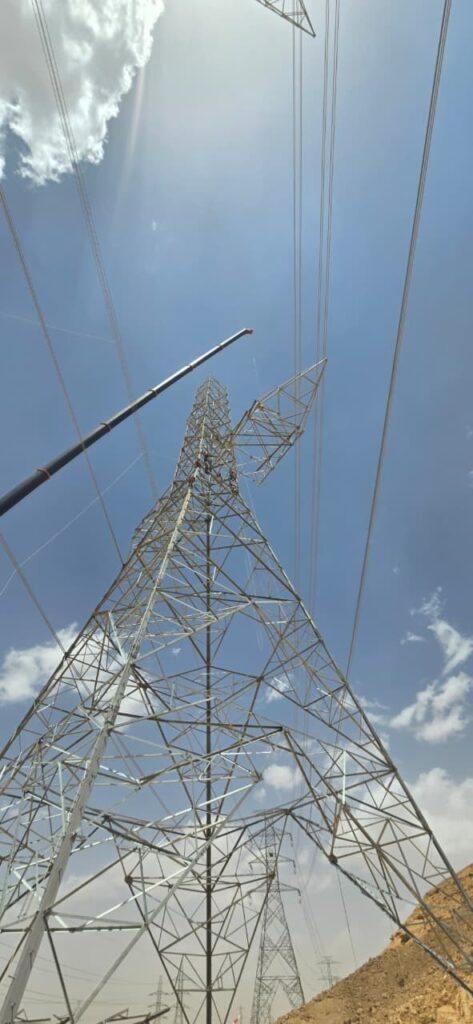
Lifting operations in Overhead Transmission Line (OHTL) tower erection are among the most critical and high-risk construction activities. These operations involve heavy steel components, complex geometries, environmental forces, and often work near energized lines.
This article presents a structured engineering methodology for preparing safe and efficient lifting plans. It covers structural segmentation, load calculations, crane selection, rigging design, and site risk assessment.
A real-world case study of a 380kV double-circuit transmission tower demonstrates how proper planning—such as maintaining low crane utilization and controlled lifting radius—can significantly improve safety and operational efficiency.
Keywords
OHTL Lifting Plan, Tower Erection, Crane Selection, Rigging Design, Load Calculation, Transmission Line Safety, Construction Engineering
1. Introduction
The erection of OHTL towers requires lifting heavy structural components to considerable heights under challenging site conditions. These activities become even more critical when performed near live transmission lines.
Common risks include:
- Crane instability
- Load swing and loss of control
- Structural misalignment
- Electrical hazards
Traditionally, lifting plans were treated as basic procedural documents. However, modern engineering practice requires a more analytical approach, where lifting operations are treated as engineered systems based on physics, structural behavior, and safety principles.
2. Engineering Methodology for Lift Planning
2.1 Structural Segmentation and Configuration Analysis
The first step in lift planning is analyzing the tower structure using design drawings.
Key elements to identify:
- Tower type (Suspension, Tension, Terminal)
- Structural components (legs, body, cross arms, peak)
- Erection sequence
The tower is divided into smaller lifting segments (panels) to:
- Reduce load per lift
- Improve lifting stability
- Ensure better control during hoisting
Each segment must be analyzed for:
- Center of Gravity (COG)
- Proper lifting points
- Stability during lifting
2.2 Load Modeling and Calculation
Accurate load calculation is essential for safe lifting operations.
The total load is calculated as:
Total Load = Component Weight + Rigging Weight + Dynamic Factor
Where:
- Component Weight = Steel member weight
- Rigging Weight = Slings, shackles, hooks
- Dynamic Factor (10%–25%) accounts for movement and impact
Important Engineering Considerations:
- Lower sling angles increase tension in slings
- Incorrect COG leads to uneven loading
- Wind can significantly affect large structural members
2.3 Crane Selection and Optimization
Selecting the right crane is critical for safe lifting.
Key factors:
- Maximum load capacity
- Working radius
- Required lifting height
Using crane load charts:
- Actual Load must always be less than Rated Capacity
Best Practice:
- Crane utilization should be ≤ 75%
- For critical lifts, aim for ≤ 60%
Why Lower Utilization Matters:
- Higher safety margin
- Better control under dynamic conditions
- Reduced risk of overloading
2.4 Crane Positioning and Ground Assessment
Proper crane positioning helps improve safety and efficiency.
Objectives:
- Minimize working radius
- Maintain stable lifting geometry
- Reduce crane movement
Ground Engineering Checks:
- Soil bearing capacity
- Outrigger load distribution
- Use of crane mats or steel plates
Poor ground conditions are one of the leading causes of crane failures worldwide, making this step extremely important.
2.5 Lift Simulation and Radius Control
Each lift must be evaluated throughout its full movement:
- Pick radius (starting point)
- Set radius (final position)
- Maximum load condition
Key Insight:
Lifting radius has a greater impact on safety than load weight alone
Because:
- Load capacity reduces as radius increases
- Dynamic effects increase with movement
- Stability decreases at higher radii
3. Execution Strategy
Execution must follow strict engineering and safety controls.
Pre-Lift Activities:
- Conduct pre-lift meeting
- Define roles and responsibilities
- Identify hazards
On-Site Controls:
- Equipment inspection and certification
- Establish exclusion zones
- Ensure proper communication (radio + signalman)
Safety Measures:
- Use tag lines to control load swing
- Monitor wind conditions
- Assign a lift supervisor with full authority
4. Risk Assessment and Mitigation
4.1 Electrical Risks
- Working near energized lines
- Maintain minimum clearance
- Assign dedicated safety observer
4.2 Crane Stability Risks
- Overloading
- Excessive lifting radius
- Weak ground support
4.3 Mechanical Risks
- Load swing
- Rigging failure
- Structural collision
Mitigation Tools:
- Job Safety Analysis (JSA)
- Permit to Work (PTW) system
- Compliance with international safety standards
5. Case Study: 380kV Double-Circuit Tower
5.1 Project Overview
A high-voltage transmission tower was erected under constrained site conditions and near energized lines, requiring precise planning and execution.
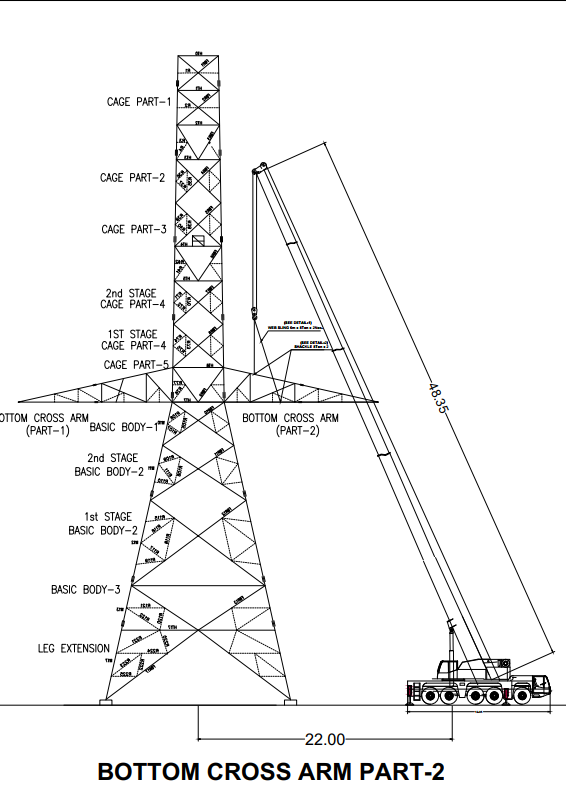
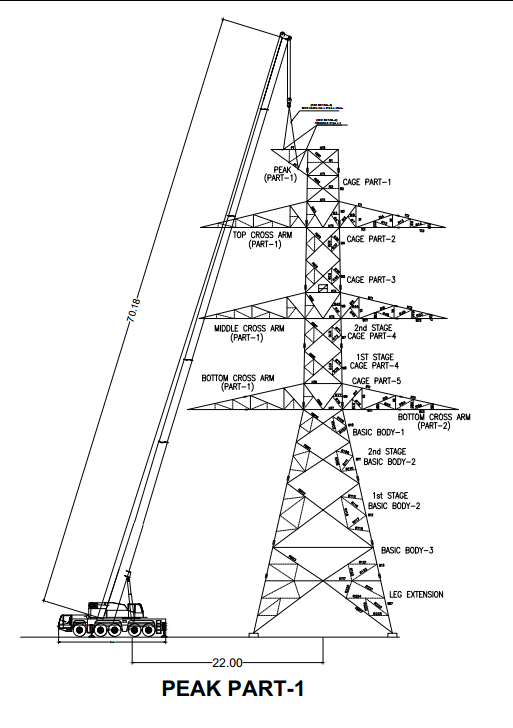
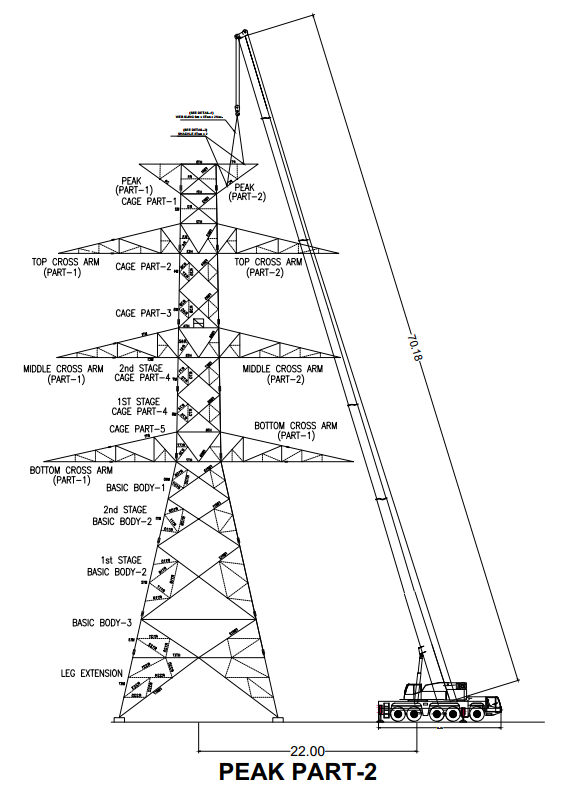
5.2 Lifting Configuration
- Crane Capacity: 160 Ton Mobile Crane
- Working Radius: 22 meters
- Boom Length: 74 meters
5.3 Load Analysis
| Component | Load (Ton) | Crane Capacity (Ton) | Utilization |
|---|---|---|---|
| Peak | 0.95 | 11.0 | 9% |
| Cross Arm | 2.9 | 13.2 | 22% |
| Cage | 3.8 | 11.3 | 34% |
5.4 Key Findings
- All lifts were below 35% crane utilization
- Strong safety margins maintained
- Stable lifting radius ensured
- Minimal dynamic effects observed
6. Discussion
This study highlights that a well-engineered lifting plan significantly improves both safety and efficiency in OHTL tower erection.
Key Takeaways:
- Conservative crane utilization reduces risk
- Controlling lifting radius is critical
- Proper segmentation improves lift stability
- Ground assessment is as important as load calculation
By adopting a systematic engineering approach, lifting operations can be transformed from high-risk activities into controlled and predictable processes.
Conclusion
Safe lifting in OHTL projects is not just about following procedures—it is about applying engineering principles to every stage of planning and execution.
A structured lifting methodology ensures:
- Enhanced safety
- Reduced operational risk
- Improved project efficiency
For engineers and project managers in transmission line construction, investing time in detailed lift planning is essential for achieving zero-incident projects.
LOOKING FOR PLS CADD TRAINING? GET IN TOUCH WITH US: https://wa.me/966566537249?text=Hello%2C%20I%20am%20interested%20in%20PLS%20CADD%20training.%20Please%20share%20details .

Eng. Mohamed Essam
Senior Civil Construction Engineer | Infrastructure & OHTL SpecialistNationality: Egyptian
LinkedIn Profile
Eng. Mohamed Essam is a Civil Engineer with over 10 years of experience in the execution and management of infrastructure projects, including substation works and high-voltage transmission lines (OHTL). He is currently leading the execution of a 380 kV Transmission Tower project within the Qiddiya Project in Riyadh, one of the Kingdom’s most prominent national initiatives.
Known for precision in field execution, strong coordination with technical teams, and a solid commitment to the highest standards of quality and safety.