
Introduction
High-voltage overhead transmission lines (OHTLs) form the backbone of modern power networks, carrying electricity across vast distances and connecting generating stations to consumers. At the heart of these systems are steel lattice transmission towers, complex structures designed to withstand extreme mechanical and environmental conditions.
However, the reliability of a transmission tower depends not only on structural design but also on the precision of the manufacturing process. Unlike conventional steel structures, transmission towers consist of thousands of individual components that must fit together perfectly during site erection.
Even minor manufacturing errors in member dimensions, bolt-hole alignment, or connection geometry can cause serious delays and costly modifications in the field. Therefore, utilities such as the Saudi Electricity Company (SEC) require manufacturers to follow strict quality standards throughout the production cycle.
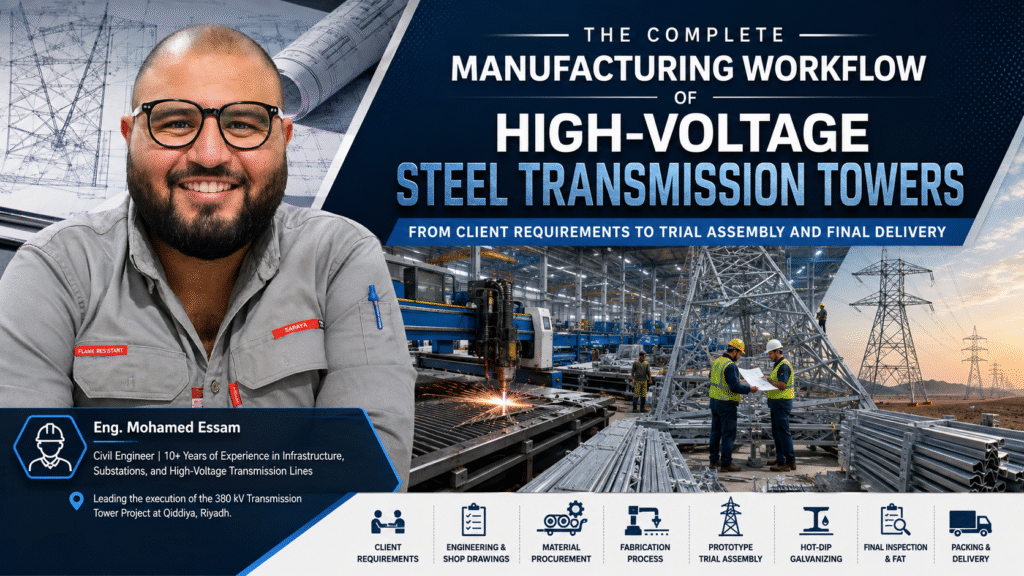
This article explains the complete manufacturing workflow of high-voltage steel transmission towers, covering every stage from engineering review and material procurement to fabrication, prototype assembly, galvanizing, inspection, and final delivery.
1. Contract Award and Engineering Review
The manufacturing process officially begins when the client awards the contract and provides the complete package of technical documentation.
The package typically includes:
- Tower design drawings
- Technical specifications
- Bill of materials (BOM)
- Structural loading schedules
- Material requirements
- Inspection procedures
- Quality standards
- Project-specific requirements
Before fabrication starts, manufacturers conduct a detailed engineering review involving multiple departments:
- Engineering
- Production
- Procurement
- Quality Assurance (QA)
- Quality Control (QC)
- Planning
- Project Management
The objective is to identify technical risks, clarify requirements, define applicable standards, and establish the overall manufacturing strategy.
At this stage, manufacturers also prepare:
- Manufacturing Quality Plan (MQP)
- Inspection and Test Plan (ITP)
- Inspection checkpoints
- Documentation requirements
- Client hold points
These documents ensure that quality is integrated into every manufacturing stage.
2. Engineering Documentation and Shop Drawings
Approved design drawings cannot be used directly on the factory floor.
Manufacturers first convert them into detailed shop drawings containing:
- Member dimensions
- Hole locations
- Connection details
- Piece marks
- Bolt information
- Material specifications
Modern manufacturers use advanced software such as:
- Tekla Structures
- Advance Steel
- AutoCAD
Using three-dimensional modeling, engineers create a digital prototype of the entire transmission tower.
The model allows engineers to:
- Detect clashes
- Verify member compatibility
- Confirm assembly sequences
- Reduce fabrication errors
- Optimize production planning
The software automatically generates:
- CNC files
- Cutting lists
- Material schedules
- Bolt schedules
- Weight reports
- Packing lists
Shop drawings become the primary reference throughout manufacturing.
3. Material Procurement and Traceability
Material procurement is one of the most critical stages in transmission tower manufacturing.
Manufacturers procure:
- Structural steel sections
- High-strength bolts
- Nuts
- Washers
- Connection accessories
All materials must comply with international standards such as:
- ASTM A572
- ASTM A394
- ASTM A563
- ASTM F436
- ASTM A6
Each shipment must include a Mill Test Certificate (MTC), which confirms:
- Chemical composition
- Mechanical properties
- Heat number
- Manufacturing origin
- Compliance with standards
Importance of Material Traceability
Every steel section receives a unique identification number that remains linked to the component throughout:
- Cutting
- Drilling
- Fabrication
- Galvanizing
- Packaging
- Shipment
Traceability enables manufacturers to identify affected members if defects are discovered.
Quality inspectors verify:
- Material grade
- Dimensions
- Straightness
- Surface condition
- Heat numbers
- Documentation
Only approved materials are released to production.
4. Steel Fabrication Process
Fabrication transforms raw steel into precisely manufactured transmission tower components.
Because all connections are bolted, transmission towers require extremely tight dimensional tolerances.
Modern factories use automated CNC production lines for:
- Cutting
- Punching
- Drilling
- Marking
- Measuring
Cutting Operations
Steel angles and plates are cut using:
- Hydraulic shears
- Band saws
- Cold saws
Inspectors verify:
- Surface quality
- Squareness
- Length accuracy
- Burr removal
Drilling and Punching
Bolt holes are produced using:
- CNC punching machines
- CNC drilling machines
Quality checks include:
- Hole diameter
- Hole spacing
- Edge distance
- Alignment accuracy
Piece Marking
Every member receives a permanent piece mark that identifies:
- Tower type
- Member location
- Production sequence
This system simplifies:
- Inventory management
- Packaging
- Site erection
- Traceability
Dimensional Inspection
Engineers verify:
- Member length
- Hole location
- Twist
- Straightness
- Overall geometry
Non-conforming members are removed and investigated immediately.
5. Prototype Trial Assembly
Prototype Trial Assembly is one of the most important quality-control activities in transmission tower manufacturing.
Its objective is to verify that all fabricated components fit together correctly before mass production begins.
Utilities such as SEC often require manufacturers to assemble the first tower of every approved design.
The trial assembly sequence generally includes:
- Foundation stub assembly
- Main legs
- Lower body section
- Diagonal bracing
- Horizontal members
- Cage section
- Cross-arms
- Tower peak
Inspectors verify:
- Hole alignment
- Member orientation
- Tower geometry
- Connection compatibility
- Constructability
The main acceptance criterion is simple:
All bolts must fit naturally without forcing, drilling, cutting, or welding.
If any modification is required, a Non-Conformance Report (NCR) is issued, followed by corrective actions.
Prototype assembly is often designated as a Hold Point or Witness Point in the Inspection and Test Plan.
The process significantly reduces:
- Site delays
- Rework costs
- Crane expenses
- Installation errors
6. Hot-Dip Galvanizing (HDG)
After successful prototype assembly, fabricated members move to hot-dip galvanizing, one of the most critical stages of the manufacturing process.
Transmission towers operate in harsh environments, including:
- Rain
- Humidity
- Coastal salt spray
- Industrial pollution
- Desert climates
- Temperature fluctuations
To prevent corrosion, utilities require all components to be galvanized according to international standards such as ASTM A123, ASTM A153, and ISO 1461.
Hot-Dip Galvanizing Process
The galvanizing process includes:
Surface Preparation
- Degreasing
- Cleaning
- Pickling
- Rinsing
- Fluxing
Zinc Immersion
Steel members are immersed in molten zinc at approximately 450°C.
Inspection
After galvanizing, inspectors verify:
- Coating thickness
- Surface quality
- Uniformity
- Adhesion
- Absence of defects
Proper galvanizing extends the service life of transmission towers for several decades.
7. Final Inspection and Factory Acceptance Test (FAT)
Before shipment, all components undergo final inspection.
Inspectors verify:
- Member identification
- Galvanizing quality
- Dimensional accuracy
- Bolt compatibility
- Package completeness
The Quality Assurance department reviews:
- Mill Test Certificates
- Inspection reports
- Calibration records
- Galvanizing certificates
- NCR reports
- Corrective actions
Many projects also require a Factory Acceptance Test (FAT), where the client and consultant verify compliance with all contractual requirements.
Successful FAT approval authorizes shipment to the project site.
8. Packing, Identification, and Shipment
Proper packaging protects members during transportation and simplifies site erection.
Transmission tower members are grouped according to:
- Tower number
- Structural section
- Erection sequence
Each bundle contains identification labels showing:
- Tower type
- Member numbers
- Package number
- Weight
Bolts, nuts, and washers are packed separately and verified against the approved bolt schedule.
Shipping documentation includes:
- Packing lists
- Shipping lists
- Inspection release notes
- Material traceability records
9. Engineering Best Practices in Transmission Tower Manufacturing
Successful transmission tower manufacturing depends on integrating quality into every stage of production.
Industry best practices include:
- 3D modeling and clash detection
- Full material traceability
- Automated CNC fabrication
- Continuous inspection
- Prototype trial assembly
- Controlled galvanizing processes
- Comprehensive documentation
Among all quality activities, prototype trial assembly remains the most effective method for detecting manufacturing issues before field erection.
Conclusion
The manufacturing of high-voltage steel transmission towers is far more than conventional steel fabrication. It is a comprehensive engineering process that integrates design, material control, precision manufacturing, galvanizing, inspection, testing, and logistics.
Modern manufacturing technologies, digital engineering tools, and internationally recognized standards have dramatically improved production quality and reliability. Nevertheless, the success of any transmission line project still depends on disciplined execution and continuous quality control.
For engineers, inspectors, consultants, and project managers, understanding this workflow provides valuable insight into how manufacturing quality directly influences construction efficiency, structural safety, and long-term performance.
The reliability of a transmission line begins long before the first tower is erected—it begins inside the factory.

Eng. Mohamed Essam
Senior Civil Construction Engineer | Infrastructure & OHTL SpecialistNationality: Egyptian
LinkedIn Profile
Eng. Mohamed Essam is a Civil Engineer with over 10 years of experience in the execution and management of infrastructure projects, including substation works and high-voltage transmission lines (OHTL). He is currently leading the execution of a 380 kV Transmission Tower project within the Qiddiya Project in Riyadh, one of the Kingdom’s most prominent national initiatives.
Known for precision in field execution, strong coordination with technical teams, and a solid commitment to the highest standards of quality and safety.